Hi, How Can We Help You?

Category Archives: Criminal Defense

What Is Parallel Construction? When Police Hide the Real Source of an Investigation

If you or a loved one is facing criminal charges in Phoenix or anywhere in Maricopa County, one of the most important questions is…

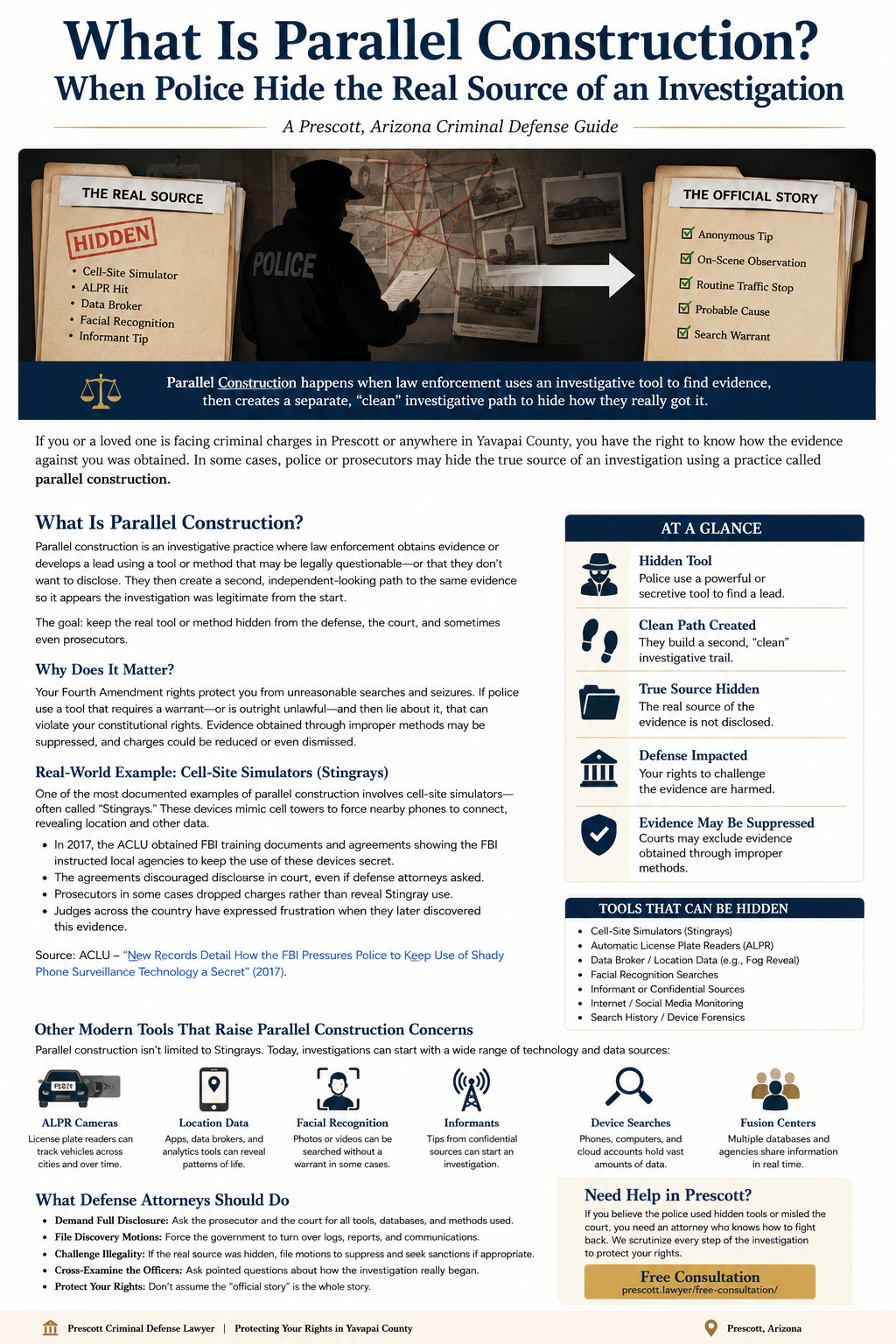
Infographic explaining parallel construction in criminal investigations, where police hide the real source of evidence and create a separate official story


“How did law enforcement really find the evidence?”


Sometimes, the official police report tells a simple story: an officer saw something suspicious, made a traffic stop, searched a vehicle, or followed up on an anonymous tip.


But in some investigations, the real starting point may be hidden. A secret database search, cell phone tracking tool, confidential federal tip, license plate reader hit, data-broker search, or surveillance technology may have pointed police in the right direction first.


When law enforcement creates a second, cleaner-looking explanation for how the case began, that practice is often called parallel construction.


This guide explains what parallel construction is, why it matters, and why defendants in Phoenix and Maricopa County criminal cases should care about the true source of the evidence.


If you want the full criminal case roadmap first, start here:

Case Stages

This infographic explains how parallel construction can hide the true source of an investigation and why that matters in a Phoenix criminal defense case.


First Things First: What Is Parallel Construction?

Parallel construction is when law enforcement uses one investigative source to find a lead, but later builds a separate explanation for how that evidence was discovered.

In plain English, it can look like this:

  • A hidden tool or secret tip points police toward a suspect.
  • Police then create a separate investigative path.
  • The official report focuses on the second path.
  • The defense may never learn how the investigation truly began.

Human Rights Watch has described parallel construction as the use of alternative explanations for how evidence was found, warning that it can prevent courts from reviewing the legality of questionable investigative methods.
Human Rights Watch – Secret Evidence Erodes Fair Trial Rights

This does not mean every police report is false. It means that in some cases, the written report may not reveal the full investigative path.


Why Parallel Construction Matters in a Phoenix Criminal Case

The source of evidence matters because criminal defendants have the right to challenge illegal searches, unreliable technology, and improper government conduct.

If the real source of a case is hidden, the defense may lose the chance to ask critical questions:

  • Was a warrant required?
  • Was the warrant valid?
  • Was a surveillance tool used?
  • Was the technology reliable?
  • Was the evidence obtained through an illegal search?
  • Was the defendant misidentified?
  • Did officers leave important facts out of the report?

That matters in Phoenix felony and misdemeanor cases because early investigative decisions can affect everything that follows, including complaint, indictment, arrest, arraignment, pretrial motions, plea negotiations, and trial.


Why Parallel Construction Concerns Are Especially Relevant in Phoenix

Phoenix is the largest city in Arizona and criminal investigations here may involve local, county, state, and federal agencies. A Phoenix case may begin with Phoenix Police, Maricopa County agencies, state investigators, federal task forces, or shared law enforcement intelligence.

Because the Phoenix metro area is so large, investigations may also involve surveillance cameras, license plate readers, cell phone location tools, confidential informants, social media monitoring, federal database searches, and interagency information sharing.

In a Maricopa County criminal case, the first police report may not always show the full path that led officers to a suspect, vehicle, phone, address, or search. That is why discovery and pretrial investigation are so important.

For more on felony cases in Maricopa County Superior Court, see:

Superior Court Case in Maricopa County


The DEA Special Operations Division Example

One of the best-known public examples of parallel construction came from reporting on the Drug Enforcement Administration’s Special Operations Division.

Reuters reporting, later summarized by Investigative Reporters & Editors, described a secretive DEA unit that funneled information from intelligence intercepts, wiretaps, informants, and phone-record databases to law enforcement agencies to help launch criminal investigations. According to that reporting, agents were instructed to recreate the investigative trail so the original source would not appear in court records.
Investigative Reporters & Editors summary of Reuters report

EFF also summarized the issue as “intelligence laundering,” explaining that government tips could be used to start investigations while the original source of the information stayed hidden from defendants and courts.
Electronic Frontier Foundation – DEA and NSA Intelligence Laundering

The key point is simple: if an investigation starts with hidden intelligence, the defense may need to know that in order to test whether the case was built legally.


Cell-Site Simulators: The Stingray Secrecy Problem

Another documented example involves cell-site simulators, often called Stingrays. These devices can mimic cell towers and force nearby phones to connect, allowing law enforcement to locate or identify phones.

The ACLU obtained records showing that the FBI continued to impose nondisclosure agreements on law enforcement agencies seeking to use FBI cell-site simulators. Those records raised concerns that secrecy rules could limit what police disclose to courts, prosecutors, defense attorneys, and the public.
ACLU v. FBI – Cell-Site Simulator NDA Records

This matters because a defendant cannot challenge a surveillance tool if no one admits the tool was used.

Arizona has seen related litigation too. In Hodai v. City of Tucson, the ACLU of Arizona challenged Tucson’s refusal to produce Stingray-related public records. The city relied on a nondisclosure agreement involving Harris Corporation, the company associated with Stingray devices.
ACLU of Arizona – Hodai v. City of Tucson


How Parallel Construction Can Show Up in Ordinary Phoenix Cases

Parallel construction does not always announce itself. It may appear through vague language in police reports, such as:

  • “acting on information received,”
  • “based on an anonymous tip,”
  • “through investigative means,”
  • “officers developed information,”
  • “a known law enforcement database indicated,”
  • “the suspect was located after further investigation.”

None of those phrases automatically proves misconduct. But they can be warning signs that the defense should ask more questions.

For example, a case that appears to begin with a routine traffic stop near Phoenix may actually have started with:

  • a license plate reader alert,
  • a cell phone location search,
  • a confidential informant tip,
  • a federal task-force alert,
  • facial recognition software,
  • a social media monitoring tool,
  • a private camera network,
  • or a data-broker search.

That hidden first step can matter if the officer later claims the case began only with a “routine” observation.


Modern Tools That Can Create Hidden Investigative Leads

Parallel construction concerns are growing because modern investigations can involve tools that ordinary people may never see in a police report.

License Plate Reader Hits

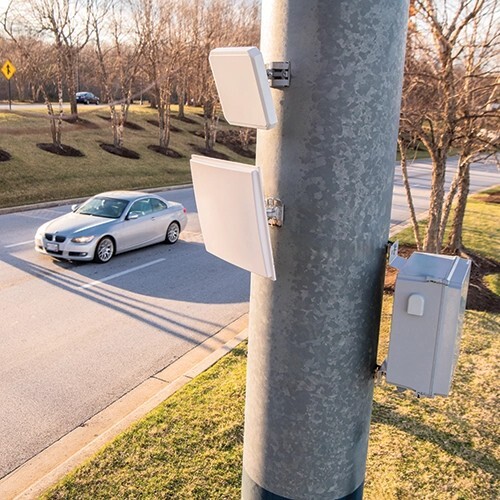
Automatic license plate readers can scan plates, record vehicle location data, and generate alerts when a vehicle appears in a certain area. If an officer later stops the car for a traffic reason, the report may focus on the traffic violation instead of the original database alert.

Phone Location Data and Data Brokers

Some law enforcement agencies have used commercially available location data products. Those tools can raise serious discovery questions because the data may come from apps, advertising identifiers, or third-party brokers rather than a traditional warrant.

Cell-Site Simulators

A cell-site simulator may help locate a phone, but the official report may not say that such a tool was used unless the defense specifically asks and the court orders disclosure.

Facial Recognition Leads

Facial recognition can generate a lead, but a later investigation may rely on witness identification, surveillance footage, or officer observation instead. The defense may need to know whether software influenced the investigation.

Confidential Informants and Task-Force Tips

Informants and interagency task forces can produce valuable leads, but vague references to “information received” can leave the defense guessing about reliability, bias, or legality.


Why This Is a Fourth Amendment Issue

The Fourth Amendment protects people from unreasonable searches and seizures. If evidence comes from an unlawful search, the defense may be able to ask the court to suppress it.

But suppression motions depend on knowing what happened.

If the real source of the evidence is hidden, a judge may never get the chance to decide whether police used an unconstitutional method.

The U.S. Supreme Court has also limited when evidence is excluded from court. In Herring v. United States, the Court explained that the exclusionary rule focuses heavily on deterrence and law enforcement culpability, not every police mistake automatically results in suppression.
Herring v. United States, 555 U.S. 135 (2009)

That makes accurate disclosure even more important. If the court does not know the real facts, it cannot properly decide whether evidence should be admitted or excluded.


What Defense Lawyers Look for in Discovery

In a Phoenix criminal case, discovery is where the defense starts asking what the State actually has and how the case was built.

Important discovery questions may include:

  • Were any law enforcement databases searched?
  • Was a license plate reader involved?
  • Was a cell-site simulator used?
  • Was location data purchased or accessed from a third-party vendor?
  • Was facial recognition used?
  • Was a federal, state, or local task force involved?
  • Was there an informant or confidential source?
  • Were there reports, logs, alerts, emails, or audit trails not included in the police report?
  • Were any search warrants, subpoenas, court orders, or preservation requests used?

These questions are especially important during the preliminary hearing and pretrial stages, when the defense may challenge probable cause, search legality, or the reliability of the State’s evidence.

For more on the pretrial phase, see:

Pretrial Conference


Why Police Reports May Not Tell the Whole Story

A police report is important, but it is not always the full investigation.

Reports may leave out:

  • database searches,
  • federal task-force communications,
  • surveillance technology logs,
  • informant communications,
  • private camera or ALPR alerts,
  • vendor tools used before the stop,
  • or internal emails between agencies.

That is why early legal representation matters. A defense lawyer can compare the report against body-camera footage, dispatch logs, warrant materials, jail calls, digital evidence, and discovery disclosures.

If you or a loved one was recently arrested, this guide may also help:

What Happens After a Felony Arrest in Phoenix, Arizona


What Can Happen If Parallel Construction Is Exposed?

If the defense uncovers that law enforcement hid the real source of an investigation, several things may happen depending on the facts:

  • The defense may request additional discovery.
  • The court may order the State to disclose records.
  • The defense may file a motion to suppress evidence.
  • The prosecution may have to explain how the investigation truly began.
  • The judge may hold an evidentiary hearing.
  • In some cases, evidence may be excluded.
  • In serious cases, charges may be reduced or dismissed.

The outcome depends on the facts, the technology involved, the legality of the search, and whether the defense can show that the hidden source affected constitutional rights.


Questions to Ask If You Suspect Hidden Surveillance Was Used

If something about the case feels too neat, too fast, or too vague, it may be worth asking:

  • How did police know where to look?
  • How did they identify the vehicle or phone?
  • Why was that person stopped at that exact time?
  • Was the stop truly random?
  • Was an ALPR alert involved?
  • Was a federal agency involved?
  • Were there sealed records or undisclosed warrants?
  • Was the “tip” really from a person, or from a database?

Those questions do not prove the case is invalid. But they can help reveal whether the official story matches the real investigation.


Frequently Asked Questions About Parallel Construction

What is parallel construction in criminal law?

Parallel construction is when law enforcement creates a separate investigative path to explain evidence while hiding the original source that led police to it.

Is parallel construction illegal?

Not every use of parallel construction is automatically illegal, but it can raise serious constitutional, discovery, and fair-trial concerns if it hides unlawful searches or prevents the defense from challenging the evidence.

Why does the source of evidence matter?

The defense has the right to challenge illegal searches, unreliable technology, and improper investigative methods. If the real source is hidden, those challenges may be blocked.

Can parallel construction happen in Phoenix cases?

Yes. Phoenix cases can involve federal tips, task-force information, license plate readers, phone-location tools, informants, or other outside sources.

How can a defense lawyer find hidden investigative tools?

A defense lawyer can request discovery, review reports and videos, examine warrant materials, subpoena records when appropriate, and ask targeted questions about databases, surveillance tools, informants, and interagency communications.

Can evidence be suppressed if the real source was hidden?

Possibly. If the evidence came from an unlawful search or if the State failed to disclose important information, the defense may be able to file a motion to suppress or request other remedies.

Does a vague police report prove parallel construction?

No. Vague language alone does not prove misconduct. But phrases like “information received” or “investigative means” may justify deeper discovery questions.

Should I talk to police if I think hidden surveillance was used?

No. It is usually best to remain silent and speak with a criminal defense lawyer before discussing the facts of the case.


Facing Criminal Charges in Phoenix? The Real Source of the Evidence Matters

The official story is not always the whole story. In modern criminal investigations, evidence may begin with databases, surveillance tools, confidential tips, or interagency information that never appears clearly in the first police report.

If you are facing charges in Phoenix or anywhere in Maricopa County, a criminal defense lawyer can examine how the investigation really began and whether your rights were violated.

Start here:

Ted Law

or request help here:

Free Consultation


How Bail and Bond Work After a Felony Arrest in Phoenix, Arizona

After a felony arrest in Phoenix, one of the first questions families ask is:
“Can they get out?” In Maricopa County, the answer depends on the charge, the person’s history, and what a judge orders at the
initial appearance.

This guide explains bail and bond in simple terms—what they are, how judges decide release, what “OR release” means, and what to do if the bond amount is too high.
If you want the full step-by-step criminal process first, start here:
What Happens After a Felony Arrest in Phoenix, Arizona.


First Things First: “Bail” vs. “Bond” (Plain English)

People often use the words “bail” and “bond” as if they mean the same thing. They’re related, but not identical:

  • Bail is the legal concept: the court’s decision to release someone while the case is pending, usually with conditions.
  • Bond is one possible condition of bail: money (or a financial guarantee) used to encourage the person to return to court.

Sometimes there is no bond at all—the person may be released on a promise to appear, or held in custody depending on the facts.


When Bail and Bond Get Decided in Phoenix Felony Cases

In Arizona, an arrested person must typically be brought before a judge for an initial appearance within about 24 hours (or released if that does not happen).
You can read an official overview of the criminal case steps here:
Arizona Judicial Branch – Steps in a Criminal Case.

In Phoenix felony matters, the initial appearance is where the judge addresses:

  • the charge(s) and basic rights,
  • whether the person can be released,
  • what conditions apply (including bond), and
  • what happens next in the court process.

For more on the initial appearance stage, see:
Initial Appearance (IA).


What Judges Look At When Setting Release Conditions

Judges do not set bond randomly. They weigh several factors to decide whether someone can be safely released and whether money is needed to ensure the person comes back.
Common factors include:

  • Seriousness of the allegation (and whether violence or weapons are alleged)
  • Prior criminal history (including missed court dates)
  • Flight risk (ties to the area, work, family, stable residence)
  • Public safety concerns
  • Victim safety concerns (often raised in assault or domestic violence-related cases)

Phoenix cases are handled through Maricopa County courts, and felony cases often move into Superior Court.
If you want a helpful overview of felony procedure there, see:
Superior Court Case in Maricopa County.


The 4 Types of Release in Arizona (Including OR and Bond)

Ted Law’s “Release” page breaks this down clearly. Here’s the big picture:
Release (Four Types of Release).

1) Own Recognizance (OR Release)

“OR” means the court releases someone based on a promise to appear in court. OR release can still come with strict conditions, like no-contact orders or drug testing.

2) Secured Bond (Money Bond)

A secured bond means the court sets a dollar amount. The person may need to post that amount (or use a bail bond company, depending on the bond type and terms).
If the person returns to court as ordered, the bond is generally handled according to court rules. If the person misses court, bond can be forfeited and warrants can issue.

3) Supervised Release / Pretrial Supervision

Some people are released under supervision—meaning they must follow rules like check-ins, GPS monitoring, testing, or travel restrictions. This can be ordered with or without a bond.

4) Held in Custody (No Release at That Time)

In some cases, a judge may keep a person in custody—at least until a later hearing. This can happen when the court believes release is not appropriate under the circumstances
or when the case posture requires additional review.


Common Release Conditions in Phoenix (Even If You Post Bond)

Many people assume bond is the only thing that matters. In reality, conditions can be just as important as the money. Common conditions include:

  • No-contact orders (direct or indirect contact)
  • Stay-away orders (home, workplace, school, specific locations)
  • Drug/alcohol testing or treatment requirements
  • No weapons / firearm restrictions
  • Travel restrictions (sometimes permission required to leave Arizona)
  • Reporting requirements to pretrial services

Violating conditions can send someone back to custody—even if the bond was posted. If you want the full “roadmap” of what happens next in the case after release,
use the hub page here: Case Stages.


Where People Are Held After a Phoenix Felony Arrest

In the Phoenix metro area, it’s common for people facing felony charges to be housed at facilities like the 4th Ave Jail.
Ted Law has a helpful local resource here:
Booking and Processing (4th Ave Jail – Phoenix, AZ).

The practical reason this matters: release decisions happen fast, and families often scramble to find out where a person is held, what the bond is, and what the next court date will be.


What If the Bond Is Too High?

If bond is set higher than your family can reasonably pay, it does not mean the case is “over.” But it does mean you must act carefully and quickly.
Depending on the case posture, a lawyer may be able to request a review or modification of release conditions.

Just as important: people sometimes panic and make mistakes—contacting alleged victims, sending texts that violate conditions, or talking on recorded jail lines.
Those choices can make release harder later.


Why Early Legal Help Can Change the Release Outcome

Release decisions often happen with limited information. A criminal defense lawyer can help by:

  • presenting stable community ties (work, family, residence)
  • addressing risk concerns (supervision options, compliance plan)
  • pushing for reasonable conditions instead of unnecessary restrictions
  • protecting the client from self-incrimination early in the case

If you need help quickly, you can start here:
Free Consultation.


Frequently Asked Questions About Bail and Bond in Phoenix

How fast is bond set after a felony arrest in Phoenix?

Bond and release conditions are commonly addressed at the initial appearance, which typically happens within about 24 hours of arrest (timing can vary).

If I post bond, does that mean the case goes away?

No. Posting bond only affects release while the case is pending. The criminal case continues through stages like arraignment, pretrial conferences, and possibly trial.
See: Case Stages.

What is OR release in Arizona?

OR (own recognizance) release means the court releases someone based on a promise to appear in court. Conditions can still apply. See:
Release.

Can I get out without paying bond?

Sometimes. Depending on the judge’s assessment of risk and the allegations, a person may be released OR or under supervision without a secured bond.

What happens if someone violates release conditions after bonding out?

The court can revoke release, issue a warrant, impose stricter conditions, or order custody. Even “small” violations—like indirect contact—can cause big problems.

Do Phoenix felony cases always go to Superior Court?

Many felony cases proceed through Maricopa County Superior Court. For an overview of what that looks like, see:
Superior Court Case in Maricopa County.


Need Help Navigating Release After a Phoenix Felony Arrest?

Bail and bond decisions are made early, and early mistakes can follow you for months. If you or a loved one was arrested in Phoenix or anywhere in Maricopa County,
getting clear guidance quickly can help you avoid violations, protect rights, and work toward better conditions.

To talk with a criminal defense team, start here:
Ted Law or request a call back here:
Free Consultation.


What Happens After a Felony Arrest in Phoenix, Arizona

Felony cases in Phoenix are handled through Maricopa County courts, where procedures, timelines, and prosecutorial practices can differ significantly from other parts of Arizona. Because Phoenix is the largest city in the state, felony cases often move quickly and are prosecuted aggressively.

Being arrested for a felony in Phoenix is an overwhelming experience. Many people have never had contact with the criminal justice system before, yet suddenly they are facing serious accusations, potential prison time, and consequences that could affect their freedom, employment, and family for years to come.

Understanding what happens after a felony arrest in Phoenix can help you regain a sense of control and avoid costly mistakes early in the process.


Step 1: The Felony Arrest

A felony arrest in Phoenix may occur following:

  • A police investigation

  • A traffic stop or roadside encounter

  • An alleged domestic violence incident

  • Drug, weapon, or violent crime allegations

  • An arrest warrant issued by a judge

After the arrest, officers will typically transport you to jail for booking, which includes fingerprinting, photographs, and basic personal information. Law enforcement may attempt to question you during this time.

Important: Exercise Your Rights

You are not required to answer questions about the alleged offense. Statements made after an arrest can be used against you later in court.


Step 2: Booking and Jail Detention

After booking, several outcomes are possible depending on the charge and circumstances:

  • Release with a future court date

  • Continued detention until an initial appearance

  • Detention without immediate bond for serious offenses

Felony release decisions in Phoenix often depend on:

  • The severity of the charge

  • Prior criminal history

  • Flight risk

  • Public safety considerations


Step 3: Initial Appearance Before a Judge

An initial appearance usually occurs within 24 hours of a felony arrest.

At this hearing, a judge will:

  • Inform you of the charges

  • Advise you of your constitutional rights

  • Decide release conditions or bond

  • Schedule future court dates

This hearing does not determine guilt or innocence, but it can significantly affect whether you remain in custody while your case proceeds.

Early involvement from a criminal defense lawyer can influence release conditions and help protect your rights from the start.


Step 4: Felony Charges Filed by the Prosecutor

Following arrest, the Maricopa County Attorney’s Office reviews the case to determine whether to formally file felony charges. Prosecutors rely on:

  • Police reports

  • Physical and digital evidence

  • Witness statements

Not every arrest results in charges. In some situations, cases are delayed, reduced, or declined altogether. Early legal advocacy can sometimes prevent weak cases from moving forward.


Step 5: Arraignment

At the arraignment, formal felony charges are presented, and the defendant enters a plea:

  • Not guilty

  • Guilty (rare at this stage)

  • No contest

Most defendants enter a not guilty plea initially to preserve legal defenses and allow time for investigation.

The court may also impose:

  • Release conditions

  • No-contact orders

  • Travel restrictions


Step 6: Pretrial Phase and Case Investigation

The pretrial phase is often the most critical part of a felony case.

During this stage, a defense attorney may:

  • Review all evidence and reports

  • Analyze body-camera and surveillance footage

  • Challenge illegal searches or arrests

  • Identify constitutional violations

  • Interview witnesses

  • File motions to suppress evidence

Many felony cases resolve during pretrial through:

  • Charge reductions

  • Dismissals

  • Negotiated plea agreements


Step 7: Grand Jury or Preliminary Hearing

In some Phoenix felony cases, prosecutors must establish probable cause through either:

  • A grand jury proceeding, or

  • A preliminary hearing before a judge

Defense involvement at this stage can expose weaknesses in the prosecution’s evidence early in the process.


Step 8: Trial (If the Case Does Not Resolve)

If a felony case proceeds to trial, it typically includes:

  • Jury selection

  • Opening statements

  • Witness testimony

  • Cross-examination

  • Closing arguments

The prosecution must prove guilt beyond a reasonable doubt, a high legal standard. Although many cases resolve before trial, preparation for trial strengthens negotiation leverage.


Step 9: Verdict and Sentencing

If a verdict is reached:

  • Not guilty → the case ends

  • Guilty → sentencing follows

Felony sentencing in Phoenix may involve:

  • Prison or jail

  • Probation

  • Fines

  • Court-ordered programs or treatment

  • Long-term consequences such as loss of civil rights

Sentencing outcomes vary widely depending on the offense, criminal history, and legal strategy.


Why Early Legal Representation Matters After a Felony Arrest

Felony cases carry serious, long-term consequences. Early legal representation can:

  • Prevent self-incrimination

  • Challenge improper police conduct

  • Influence release conditions

  • Identify dismissal opportunities

  • Reduce exposure to prison time

Waiting to take action often limits available defenses.


Facing a Felony Arrest in Phoenix? Get Answers Now

If you or someone you care about has been arrested for a felony in Phoenix or anywhere in Maricopa County, understanding the process is the first step toward protecting your future.

Speaking with a criminal defense lawyer early allows you to evaluate your options, protect your rights, and respond strategically to the charges you are facing.

September 3, 2025

When is deadly force justified in Arizona?

Arizona law lets you use deadly force only when a reasonable person would believe it’s immediately necessary to stop another’s use or attempted use of unlawful deadly force:

  • Self-defense: ARS §13-405 (deadly force) & §13-404 (physical force).

  • Defense of others: ARS §13-406 (same standard applied to protecting someone else).

Home & property situations

  • Defense of premises: You may use force to prevent/terminate a criminal trespass (§13-407). Deadly force still must meet the deadly-force standard (or fall under crime-prevention, below).

  • Crime prevention (“castle-style” protection): Deadly force can be justified to stop certain serious crimes (e.g., home invasion, sexual assault) under §13-411, if a reasonable person would believe it’s immediately necessary.


When force is not justified

  • Words alone: Verbal insults/provocation aren’t enough.

  • Resisting arrest: Even if you think the officer is using too much force (address it in court).

  • Initial aggressor: If you provoked the fight, you must withdraw and clearly communicate that before claiming self-defense.

  • Innocent bystanders: Justification won’t cover reckless injury to a third person.


“Stand Your Ground” in Arizona

Arizona imposes no duty to retreat if you’re lawfully present and not committing a crime (often called “Stand Your Ground,” though AZ doesn’t use that label). If retreat is safe and obvious, jurors may still consider it when judging reasonableness.


Common real-world examples

  • Home intruder at night: If you reasonably believe the intruder poses an immediate deadly-force threat, deadly force can be justified—even if the intruder turns out to be unarmed.

  • Parking-lot confrontation: Deadly force is justified only if the other person uses or attempts to use deadly force; property disputes alone don’t qualify.

  • Third-party defense: Same rules—your belief must be reasonable and immediate.


What to do after a defensive shooting

  1. Call 911: Report the emergency, request medical help.

  2. Say little: Identify yourself, location, need for aid. Do not give a detailed statement.

  3. Ask for a lawyer: “I’m invoking my right to remain silent and I want my attorney.”

  4. Preserve evidence: Don’t move casing/shells or alter the scene; keep potential witnesses nearby.

  5. Avoid statements to insurers, bystanders, or social media.


How Ted Law defends self-defense cases

  • Justification build-out: Scene reconstruction, lighting/sightlines, 911 audio, surveillance, gunshot-residue & trajectory, medical records, prior acts of the aggressor (where admissible).

  • Reasonableness narrative: Your perceptions, timing, distances, and threat cues (weapons, disparity of force, multiple attackers).

  • Constitutional challenges: Unlawful searches, Miranda issues, coerced statements.

  • Charge reduction/alternatives: Where full justification is disputed, pursue lesser-included offenses or non-dangerous designations.


Free, confidential case review (Tempe)

Ted Law | DUI & Criminal Defense
602-453-31002233 W Baseline Rd, Ste C101, Tempe, AZ 85283
Same-day consultations. Nights & weekends available.

This page is general information, not legal advice. Your facts matter—call to discuss your specific situation.

Drug Charges & Immigration in Arizona: What Puts You at Risk (and How to Protect Yourself)

If you’re a documented or undocumented immigrant in Arizona, a drug arrest can put your status—and your future—on the line. Many drug offenses are deportable, and even “minor” cases can trigger ICE involvement. If Tempe PD, DPS, or a campus officer at ASU has cited or arrested you, getting the right lawyer involved immediately is critical.


Can Drug Charges Lead to Deportation?

Short answer: yes—often.

  • Controlled-substance convictions (possession, use, paraphernalia, sales, transport, manufacture) are generally deportable offenses under federal immigration law.

  • There’s a narrow exception for simple possession of ≤ 30 grams of marijuana for personal use—but the details matter, and paraphernalia or “for sale” allegations can blow that protection.

  • Drug trafficking (even a small sale) is treated as an aggravated felony—which can mean mandatory detention, removal, and bars to most relief.

  • You don’t always need a conviction to have immigration problems: admissions of drug use, a “reason to believe” someone trafficked drugs, or certain diversion outcomes can still cause inadmissibility or trigger removal proceedings.

Important: What counts as a “conviction” for immigration is broader than you think. A plea + any punishment (probation, classes, fines) can be a “conviction” for immigration—even if Arizona later dismisses or sets aside the case.


“Crimes of Moral Turpitude” (CIMTs) & Drug Cases

Some drug cases also include facts that make them CIMTs (e.g., fraud, violence, theft as part of the conduct). A single CIMT can cause problems; two CIMTs or a CIMT within certain timeframes can be deportable too. Prosecutors sometimes stack charges—don’t ignore the “little” add-ons.


Common Tempe Scenarios We See

  • Traffic stop near ASU → car search → pills not in your name / THC vape / cocaine residue

  • Package interceptions (mail/UPS/FedEx) tied to your address

  • Paraphernalia only cases (papers, pipe, scale, baggies)

  • Text messages cited as “intent to sell”

  • Diversion offers that look great for criminal court but destroy immigration options


Defense Goals When Immigration Is in Play

A good Tempe defense doesn’t just aim to “win the case”—it aims to protect status and relief:

  • Suppress bad stops & searches (no probable cause, invalid consent, dorm/apartment issues).

  • Negotiate to a non-deportable offense (e.g., non-drug substitute counts) when evidence is strong.

  • Avoid “drug related” admissions in plea paperwork.

  • Structure diversion so it isn’t an immigration “conviction.”

  • Vacate/withdraw past pleas if they were legally defective or your rights weren’t explained.

This is where criminal + immigration strategy has to be coordinated. Don’t accept a quick plea without asking how it lands in immigration court.


What to Do Right Now

  1. Do not discuss your case with police, probation, or “investigators.” Use your right to remain silent.

  2. Do not sign plea/diversion forms before a lawyer reviews immigration impact.

  3. Tell your attorney your exact status (USC/LPR/visa/undocumented, prior entries, pending petitions). Confidentiality protects you.

  4. Move fast. Early motions and negotiations often decide whether ICE gets involved.


We Handle Drug + Immigration Consequences Every Day

Ted Law — Tempe Criminal Defense & DUI
We defend drug cases across Maricopa County with an eye on both courtrooms: criminal and immigration. From simple possession to “intent to sell,” we work to suppress evidence, reframe charges, and protect your path to stay in the U.S.

  • Free, confidential consultation (24/7)

  • Phone: (602) 453-3100

  • Email: paralegal@tedlaw.net

  • Office: 2233 W Baseline Rd, Suite C-101, Tempe, AZ 85283

If you’re an immigrant facing a drug charge in Tempe, don’t gamble your status on a one-size-fits-all plea. Call Ted Law before you take another step.

Felony Drug Possession in Tempe: What You’re Really Up Against—and How to Fight Back

Even a single pill or a few grams of an illegal substance in your pocket can put your freedom, your finances, and your future on the line in Arizona. State law brands most possession cases as felonies; sentences can run from mandatory jail to years in prison, plus staggering fines. If Tempe police, DPS, or a campus officer at ASU has charged you—or you think an arrest is coming—read this first and contact experienced counsel immediately.


1. How Arizona Defines “Possession”

Prosecutors must prove two things beyond a reasonable doubt:

  1. Control or dominion – The drug was on your person, in your vehicle, home, backpack, or anywhere they can link to you; and

  2. Knowledge – You knew the substance existed and knew it was an illegal drug (proved through statements, fingerprints, videos, or circumstantial evidence).


2. Common Charges We See in Maricopa County

Charge Felony Level Typical Triggers
Simple Possession Class 4 (dangerous drugs or narcotics) – can drop to Class 1 misdemeanor if no priors & not meth Small amounts for personal use
Possession With Intent to Sell Class 2 Larger quantities, scales, baggies, texts, or cash
Possession of Drug Paraphernalia Class 6 Pipes, syringes, bongs, baggies, digital scales
Manufacture / Cultivation Class 2 Grow rooms, pill presses, chemical lab items
Transportation / Trafficking Class 2 Moving drugs for sale—often charged on freeways or airport

A.R.S. §§ 13-3407 (dangerous drugs), 13-3408 (narcotics), 13-3405 (marijuana).


3. Sentencing Ranges in Arizona

Substance & Circumstances First-Time Offender With 1 Prior Felony With 2+ Priors
Dangerous Drug (e.g., meth, ecstasy, LSD) 0–1 yr jail or probation; $2,000+ fine 1 – 3.75 yrs prison up to 7.5 yrs
Narcotic (e.g., cocaine, heroin, fentanyl) Same as above, but jumps to 15 yrs max with priors 3 – 15 yrs 7 – 15 yrs
Marijuana (>1 oz recreational limit) 0–6 mos jail (Class 6) to 3.75 yrs prison (Class 4 if for sale) Higher presumptive terms Up to 7.5 yrs

Fines: the greater of $2,000 or the drug’s value—plus surcharges.


4. Collateral Damage

  • Loss of job or professional license

  • Ineligibility for student aid & scholarships

  • Immigration consequences for non-citizens

  • Driver-license suspension (certain cases)

  • Background-check red flags for life


5. Defense Strategies We Use

  • Illegal Search/Seizure – bad traffic stops, warrant flaws, dorm-room searches without valid consent.

  • Lack of Knowledge – borrowed car or backpack, mistaken identity.

  • Lab & Chain-of-Custody Challenges – incorrect weight, contamination, wrong drug.

  • Medical-Use or Prop 207 Protections – cannabis amounts within legal limits.

  • Diversion / TASC / Drug Court – keep the conviction off your record.

Every case is different. Early intervention often makes the difference between a dismissal, reduced charge, or prison time.


Arrested? Don’t Talk—Call Ted Law

Ted Agnick has defended serious drug cases across Maricopa County for 25+ years. From ASU campus busts to interstate trafficking stops on I-10 or the 60, we know the local courts, prosecutors, and diversion options—and how to expose weak evidence.

Free, confidential consultation 24/7

  • Office: 2233 W Baseline Rd, Suite C-101, Tempe, AZ 85283

  • Phone: (602) 453-3100

  • Email: paralegal@tedlaw.net

Pleading Insanity in an Arizona Criminal Case

Insanity Defense in Arizona

The “insanity defense” may be the most misunderstood concept in criminal law. In Hollywood it feels like an easy way out; in real-life Arizona courtrooms it is rare, difficult to prove, and—when successful—usually leads to long-term commitment in a locked psychiatric facility rather than a walk-out-the-door acquittal.

What Does It Mean to Plead Insanity?

Under A.R.S. § 13-502 (Arizona’s insanity statute), a defendant is not criminally responsible if, at the time of the offense, he or she was suffering from a “mental disease or defect” that rendered the person incapable of either:

  • Understanding the nature and quality of the act, or
  • Knowing that the act was wrong.

Because nearly every crime requires a “guilty mind” (mens rea), proving the absence of that capacity can negate criminal liability.

Who Has the Burden of Proof?

In Arizona, the defendant bears the burden of proving insanity by “clear and convincing evidence.” That is a higher bar than “preponderance of the evidence,” but lower than “beyond a reasonable doubt.” Typically the defense must present:

  • Comprehensive psychiatric evaluations
  • Medical and mental-health records
  • Expert testimony from forensic psychologists/psychiatrists
  • Collateral evidence (school, employment, family history, etc.)

How Do Courts Measure Legal Insanity?

States use one (or a hybrid) of four historic tests. Arizona relies on a modified M’Naghten standard embedded in § 13-502, focusing on knowledge of wrongfulness or the nature of the act.

Test Key Question
M’Naghten Could the defendant understand what he was doing or that it was wrong?
Irresistible-Impulse Could the defendant control his actions?
Model Penal Code Did a mental disease prevent the defendant from appreciating criminality or conforming conduct to law?
Durham Would the crime have happened but for the mental illness?

What Happens If the Defense Succeeds?

  • The verdict is “Not Guilty by Reason of Insanity (NGRI).”
  • The judge immediately commits the person to the Arizona State Hospital for evaluation.
  • Release is possible only after doctors and the Psychiatric Security Review Board deem the patient no longer a danger—often years or decades later.

Do All States Allow an Insanity Defense?

No. Four states (Idaho, Kansas, Montana, Utah) have abolished traditional insanity pleas. Arizona still recognizes it, but also permits a “guilty except insane” verdict in certain cases, blending criminal and mental-health dispositions.

Is the Insanity Defense Right for Your Case?

Because insanity claims can backfire—juries are skeptical and failed attempts may look like admissions of the act—you should never pursue this route without skilled counsel and a vetted forensic team.

Ted Law’s Approach

  • Early psychiatric screening & selection of top experts.
  • Strategic decision-making: full NGRI, partial responsibility, or alternative defenses.
  • Negotiations with prosecutors for “guilty except insane” outcomes where appropriate.

Free Consultation – Tempe Office

Theodore A Agnick PC
2233 W Baseline Rd, Suite C-101
Tempe, AZ 85283
(602) 453-3100
paralegal@tedlaw.net

Ted Law serves clients across Maricopa County, including Scottsdale, Chandler, Mesa, Phoenix and Arizona State University.

Disclaimer: This article is for informational purposes only and does not create an attorney-client relationship. Every case is unique; consult an attorney to discuss your specific facts.


Arrest, Dismissal, or Conviction?

How to Keep a Clean Record in Arizona

Landing a new job or apartment can be tough when a background-check company reports an old arrest—even if the charges were dismissed. Arizona law draws a sharp line between an arrest or charge and a conviction. Unfortunately, many private databases—and some hiring managers—ignore the distinction. Below is a quick guide to your options under ARS 13-4051 (notation of clearance) and Arizona’s quirky Class 6 “undesignated” felony rules.

1. Dismissed or Not-Guilty? You Have No Criminal Record—But the Arrest Still Shows Up

• Arizona only creates a “criminal record” after a conviction (guilty plea, no-contest plea, or jury verdict).
• Dismissals and acquittals leave you legally innocent—yet databases still display the arrest and charge.

2. Using ARS 13-4051 to Seal or Annotate a Wrongful Arrest

ARS 13-4051 lets an actually innocent person ask the court for:

  • A formal notation that he or she was “wrongfully arrested, indicted, or charged.”
  • An order barring police, prosecutors, or courts from releasing the records.
  • Civil-damages liability against any agency that ignores the order.

Key point: “Wrongfully” means truly blameless (e.g., DUI blood test returns 0.00% BAC). A routine acquittal because the State failed to prove guilt beyond a reasonable doubt does not qualify.

3. The Class 6 Undesignated Felony Trap

Many first-time defendants plead to a “Class 6 undesignated felony.” After successful probation, the court may designate it a misdemeanor—but the change is not automatic. If you see “F-6” on your background check, one of two things probably happened:

  1. The probation officer never filed the motion to convert it.
  2. The judge signed an order, but the clerk never updated DPS or private databases.

Fixing an Undesignated Felony

  • Ask your probation officer (in writing) to file the designation motion.
  • Better: have a criminal-defense lawyer draft and file the motion directly, then follow up to ensure the record updates with DPS, NCIC, and private data brokers.

4. Practical Steps if Your Background Check Is Wrong

  1. Get documentation: docket printouts, minute entries, dismissal orders, or the ARS 13-4051 clearance order.
  2. Dispute inaccuracies with the reporting agency under the Fair Credit Reporting Act (they must correct within 30 days).
  3. Review DPS & FBI files—request your own criminal-history record and fingerprint card.
  4. Consult counsel for a motion to designate (Class 6) or to obtain an ARS 13-4051 order.

Need Help Cleaning Up Your Record in the East Valley?

Ted Law guides Tempe-area residents through record corrections, class-6 designations, clearance notations, and aggressive defense of new charges. Let us make sure old mistakes—or false accusations—don’t derail your future.

Call (602) 453-3100 or contact us online for a free confidential consultation. Phones answered 24 / 7.

Tempe Office

2233 W Baseline Rd, Suite C101
Tempe, AZ 85283
Phone: (602) 453-3100

Disclaimer: The information above is general in nature and not legal advice. Every case is different; speak with an attorney about your specific situation.


Facing a Drive-By Shooting Charge in Arizona?

Understanding ARS 13-1209 and Your Defense Options

Firearms remain a leading cause of injury and death in Arizona. State lawmakers respond with aggressive statutes targeting gun crime—none more serious than ARS 13-1209, Arizona’s drive-by-shooting law. If you have been arrested in Tempe or anywhere in Maricopa County for allegedly firing a weapon from a vehicle, you are staring down a Class 2 felony—and mandatory prison time if convicted.

What Counts as a Drive-By Shooting?

Under ARS 13-1209, it is illegal to intentionally discharge a firearm from a motor vehicle at any of the following:

  • A person
  • An occupied motor vehicle
  • An occupied structure (home, business, etc.)

You do not have to hit anyone to be charged. The mere act of firing is enough. ARS 13-1209 overlaps with other gun statutes—such as misconduct involving weapons (ARS 13-3102) and unlawful discharge (“Shannon’s Law”)—but the involvement of a vehicle elevates the offense to its own category.

Penalties for Violating ARS 13-1209

  • Class 2 felony conviction (one step below Class 1)
  • Mandatory minimum of 7 years in state prison (first offense)
  • Up to 35 years if you have prior felony convictions
  • Driver’s-license revocation (1–5 years) and destruction of the license
  • Seizure & forfeiture of the vehicle used in the shooting
  • Additional fines, restitution, probation, or community service

Given the severity, it is critical to involve counsel immediately to explore reductions—such as negotiating to an unlawful-discharge count (a Class 6 felony) or other lesser charge.

Possible Defense Strategies

The prosecution must prove guilt beyond a reasonable doubt. Depending on the facts, a Tempe criminal-defense attorney may argue:

  • Mistaken identity / wrong defendant
  • Flawed show-up or lineup procedures
  • Fourth-Amendment violations (illegal stop, search, or warrant)
  • Denial of counsel or Miranda errors
  • Inaccurate ballistics or forensic testing
  • Police-report discrepancies or officer misconduct

An aggressive defense may lead to dismissal, reduction to a lesser felony, or mitigation at sentencing.

Why Hire Ted Law?

  • Decades of combined experience with serious Arizona gun charges
  • Familiarity with Maricopa County courts, judges, and prosecutors
  • 24/7 availability for jail visits and emergency bond hearings
  • Proven track record negotiating lesser charges and avoiding mandatory prison

Call (602) 453-3100 or contact us online for a free, confidential consultation. The sooner we intervene, the better chance we have of protecting your freedom and your future.

Tempe Office

2233 W Baseline Rd, Ste C101
Tempe, AZ 85283
Phone: (602) 453-3100

Disclaimer: This article is for educational purposes only and is not legal advice. Every case is unique—consult a qualified attorney for guidance tailored to your situation.


Criminal Littering & Polluting in Arizona (A.R.S. § 13-1603)


A Quick Guide for Tempe Residents

Most of us have dropped a coffee cup, tossed a cigarette butt, or left trash behind at some point. Few realize those seemingly minor actions can lead to criminal charges in Arizona. Under A.R.S. § 13-1603, “Criminal Littering or Polluting” ranges from a Class 2 misdemeanor to a Class 6 felony depending on the circumstances. Below is an overview of how the statute works—and why even a small piece of litter can have big legal consequences if you’re cited or arrested.

How Arizona Defines Criminal Littering

Under the statute, you may be charged if you:

  • Throw, drop, place, or allow litter, destructive, or injurious material on public property or someone else’s property and do not remove it immediately.
  • Discharge sewage, oil products, or harmful substances into state waters or onto shorelines.
  • Dump earth, soil, rocks, minerals, or similar material on land without permission.

Common Examples

  • Tossing a soda can in a parking lot and driving away.
  • Dropping a cigarette butt out your car window on a Tempe freeway.
  • Illegally dumping construction debris in the desert.
  • Releasing motor-oil runoff into a storm drain.

Penalties for Criminal Littering

Classification Typical Scenario Potential Penalty*
Class 2 Misdemeanor Most littering under 50 ft from roadway or <300 lbs Up to 4 months jail & $750 fine (+ surcharges)
Class 1 Misdemeanor Destructive/injurious material within 50 ft of highway, beach, or shoreline Up to 6 months jail & $2,500 fine (+ surcharges)
Class 6 Felony Litter exceeds 300 lbs / 100 cubic ft, or dumping for commercial purpose 0.33 – 2 years prison (first offense) & up to $150,000 fine

*Penalties increase if you have prior felony convictions.

Why You Should Take These Charges Seriously

A criminal littering conviction—even a misdemeanor—can carry collateral consequences:

  • Permanent criminal record
  • Higher insurance premiums or job-application hurdles
  • Mandatory community-service or clean-up programs
  • Restitution for environmental damage

Defending Against Littering Charges

Possible defenses may include:

  • Lack of evidence that you discarded the item
  • Ownership or control issues (e.g., material blew off a truck without your knowledge)
  • Mistaken identity or inaccurate license-plate capture
  • Violation of your constitutional rights during stop, search, or seizure

An experienced defense lawyer can review citation details, challenge officer observations, and negotiate for dismissal, diversion, or reduced charges.

Charged with Criminal Littering in Tempe?

Ted Law has extensive experience defending misdemeanor and felony environmental offenses. We will analyze the facts, identify weaknesses in the State’s case, and fight for the best outcome—whether that’s dismissal, reduced penalties, or alternative sentencing.

Call (602) 453-3100 or contact us online for a free consultation. Early intervention can make all the difference.

Tempe Office

2233 W Baseline Rd, Ste C101
Tempe, AZ 85283
Phone: (602) 453-3100

Disclaimer: This article is for informational purposes only and does not constitute legal advice. Every case is unique; consult an attorney for guidance specific to your situation.