
The Biometric Meat Grinder: What Happened to the Other 249 Faces in Phoenix Facial Recognition Searches?
This article analyzes publicly documented Arizona government records, federal biometric transmission standards, Maricopa County court filings, technology procurement contracts, forensic guidelines, and sworn allegations in pending federal civil litigation. Allegations are identified as such. Nothing in this text asserts that facial recognition was utilized in a specific Maricopa County prosecution unless established by official court records or public agency disclosures.
You wake up in an interrogation room at 620 West Washington Street. You wake up at a high-risk traffic stop on Camelback Road. You wake up with your face vector-quantized into a 512-dimensional floating-point array inside a server chassis at 2102 West Encanto Boulevard in Phoenix.
When Phoenix Police detectives lean across the metal desk and say, “We matched your face to the surveillance footage,” they rely on you believing in the absolute, infallible authority of modern biometrics.
They want you to crumble. They want you to sign the plea. They want you to assume the computer doesn’t make mistakes.
There is only one question your defense attorney needs to ask:
Show us the rest of the search.
Because when the State claims a suspect was identified through automated facial-recognition software, that simple claim shatters into dozens of mandatory forensic demands under the Fourth Amendment and Arizona discovery rules.
The Arizona Counter Terrorism Information Center (ACTIC) operating in Phoenix as a joint intelligence center between the Arizona Department of Public Safety (AZDPS), the Arizona Department of Homeland Security (AZDOHS), and the FBI houses a specialized Forensic Images Unit (FIU). Official public records confirm the FIU routinely executes biometric queries across tens of millions of state, driver’s license, and federal databases on behalf of Valley law enforcement.
Here is the truth prosecutors will never write into an arrest narrative: A facial-recognition search does not output a single, definitive suspect.
It outputs a ranked candidate list based on mathematical vector similarity.
Then, a human analyst who is subject to confirmation bias, agency pressure, and visual fatigue makes a subjective choice.
That exact handoff where machine scoring ends and human subjective picking begins is where police narratives routinely bury the true origin of an investigation.
Consider one landmark Maricopa County case. According to sworn pleadings in a federal civil rights lawsuit describing an underlying AZDPS facial-recognition examination, a 2016 biometric query returned:
- 200 potential Arizona DPS candidates, and
- 50 potential FBI Next Generation Identification (NGI) candidates.
An AZDPS examiner evaluated those galleries, picked Javier Lorenzano-Nunez as a potential lead, and noted seven visual similarities.
That means the core evidentiary battle in court is not: “Did the algorithm find him?”
The real question, the one that challenges every prosecutor in Maricopa County is:
Where are the other 249 faces?
Were competing candidates ranked higher by the software? What were their specific confidence scores? Did another individual score a 96% vector match while the accused scored a 64%? Did the human examiner document visual dissimilarities? Did a second examiner independently verify the match? Are the original candidate galleries preserved in native format, or were they quietly purged during cloud migration?
These are not theoretical exercises. They are constitutional evidence questions governed by 28 C.F.R. Part 23 and Arizona Rule of Criminal Procedure 15. For anyone facing felony charges in Phoenix, Mesa, Scottsdale, Glendale, Tempe, or anywhere in Maricopa County, uncovering the true source of an identification can mean the difference between decades in prison and a complete dismissal of all charges.
This issue connects directly to our comprehensive legal guide on:
What Is Parallel Construction? When Police Hide the Real Source of an Investigation
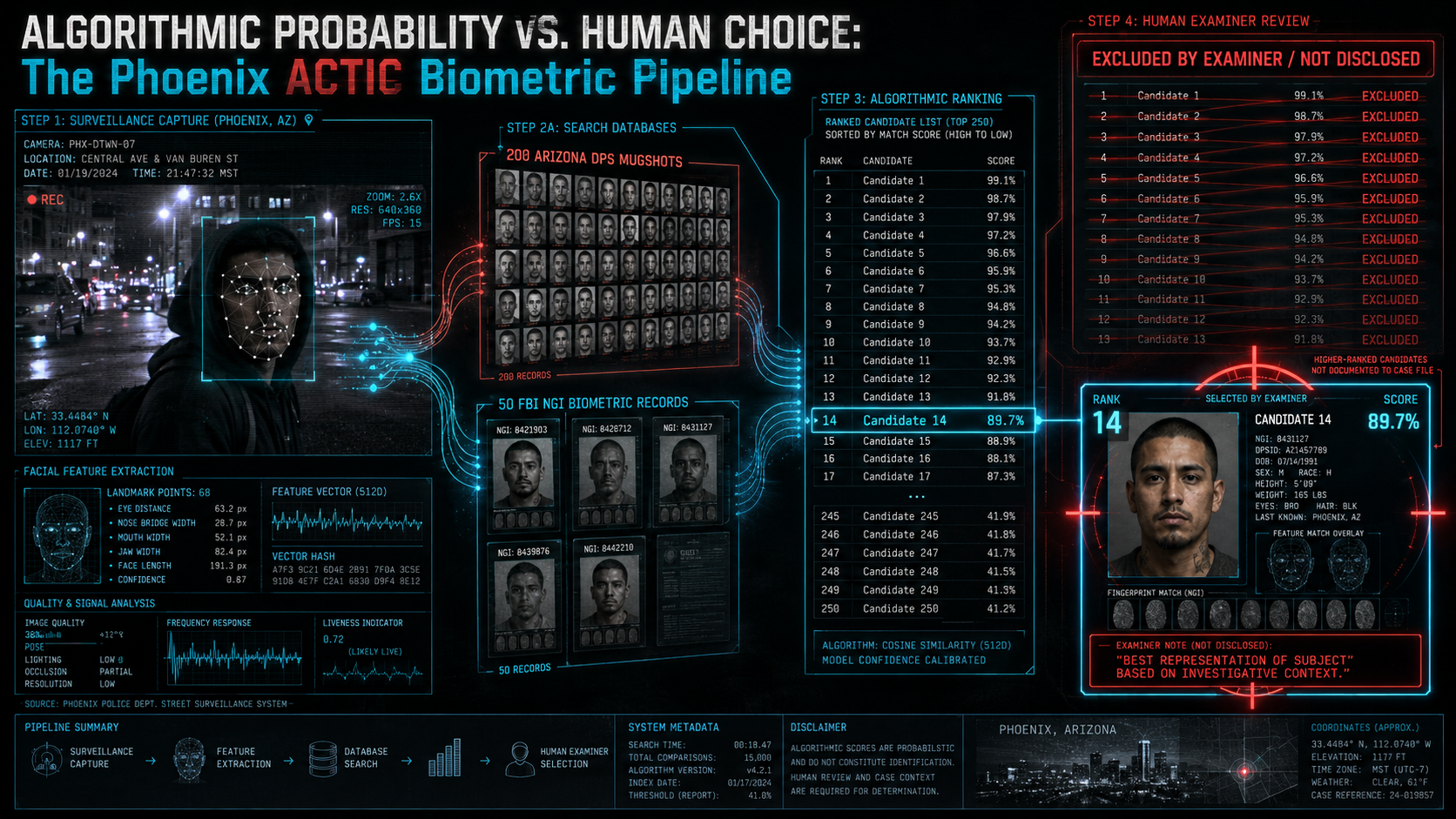
This graphic demonstrates the critical gap between an algorithmic candidate list and a human-selected investigative lead, proving why rejected candidates, similarity scores, vector rankings, and analyst worksheets are vital evidence in Phoenix criminal trials.
1. Inside the ACTIC Forensic Images Unit Infrastructure
This is not speculation. ACTIC has operated out of Phoenix since October 2004 as Arizona’s central intelligence fusion center, integrating an unclassified multi-agency unit with a classified FBI Joint Terrorism Task Force (JTTF) suite.
ACTIC’s Forensic Images Unit (FIU) provides biometrics processing for municipal police departments across the Phoenix metro area. Official agency documentation confirms the FIU executes searches across massive repositories:
- Approximately 15.7 million Arizona booking photographs;
- Approximately 30 million Arizona MVD driver-license and identification images;
- Approximately 64.7 million federal FBI NGI records;
- Arizona Missing and Exploited Children files;
- A specialized state tattoo database containing roughly 1.4 million entries;
- Specialized investigative feeds such as Spotlight for human-trafficking cases;
- And the Homeland Security Information Network (HSIN) Multistate Facial Recognition portal for regional referrals when local queries return no candidates.
Additionally, ACTIC manages a statewide Threat Liaison Officer (TLO) program linking municipal police departments throughout Maricopa County directly into fusion center databases.
Consequently, an unknown photo extracted from a Phoenix street camera, convenience store DVR, or mobile phone video can propagate through state servers, federal biometrics nodes, and national fusion portals long before a detective ever writes a probable-cause affidavit.
Examine the official agency infrastructure overview:
Arizona Counter Terrorism Information Center – AZ DPS Forensic Images Unit
2. Algorithmic Similarity vs. Human Selection: The 250-Candidate Fallacy
To dismantle a biometric identification in a Maricopa County trial, defense counsel must break the prosecution’s claim into four separate links:
PROBE IMAGE → 1:N VECTOR ALGORITHM → RANKED CANDIDATE GALLERY → HUMAN ANALYST CHOICE → INVESTIGATIVE LEAD
Automated facial recognition software operates by running a one-to-many ($1:N$) comparison. An unknown photograph (the probe image) is converted into a mathematical representation of facial nodal distances and compared against gallery templates. The software outputs a gallery ranked by similarity score.
The computer algorithm does not output a legal conclusion: “This is the person who committed the crime.”
It outputs a mathematical statement: “These gallery photos share the highest vector proximity to the probe image based on our current feature weighting.”
Standards published by the Federal Bureau of Investigation and the Facial Identification Scientific Working Group (FISWG) state that candidate returns are investigative leads only. They do not constitute probable cause without independent human verification and corroborating physical evidence.
Reference official federal guidelines:
FBI – Next Generation Identification (NGI) Biometric System
3. The Phoenix Precedent: State v. Javier Lorenzano-Nunez
The clearest real-world demonstration of this biometric pipeline appears in State v. Javier Lorenzano-Nunez (Maricopa County Superior Court No. CR2020-002309-001 DT) and its federal civil rights counterpart (Lorenzano-Nunez v. Roestenberg et al., U.S. District Court No. 2:26-cv-04153-ROS-DMF).
According to formal court filings in the 2026 federal complaint:
- 1998 Phoenix Investigation: Phoenix Police investigated an unsolved homicide. Witnesses were shown photo lineups and selected an Arizona MVD driver’s license photo of a man named Gilbert Noel Sanchez Rosado.
- The 2007 ACTIC Query (No Match): In November 2007, officers submitted Gilbert’s photo to the facial-recognition unit operating at ACTIC. That query returned zero matching candidates.
- The 2016 Query (250 Candidates): In November 2016, a Phoenix Police detective requested AZDPS to run Gilbert’s MVD photo through upgraded biometrics against state mugshots and the federal FBI NGI database.
- The Result: The state query generated 200 candidate matches, while the federal NGI search generated 50 candidate matches.
- Human Selection: An AZDPS examiner analyzed the 250-person gallery, selected Javier Lorenzano-Nunez as a potential lead, and listed seven visual points of similarity.
- Intelligence Follow-Up: An AZDPS intelligence specialist conducted background research on Javier, explicitly documenting that he had no known ties to Arizona.
Examine the federal civil complaint:
Lorenzano-Nunez Federal Civil Complaint (U.S. District Court)
4. Semantic Drift: How a Probable Lead Transformed Into an Absolute Claim
What followed highlights a critical danger in modern criminal prosecutions: semantic drift. This occurs when a low-confidence machine lead gets repeatedly rewritten in law enforcement databases until it looks like an unquestionable fact.
According to federal court pleadings, on September 24, 2020, a Maricopa County Attorney’s Office employee sent an internal email stating: “Actually, Javier is an alias in Karpel [the prosecution management software]. His name in Karpel is Gilbert Rosado.”
When Phoenix detectives presented the case to a Maricopa County grand jury in late 2020, the detective substituted Javier’s identity for Gilbert’s, testifying as if eyewitnesses had originally identified Javier from the 1998 lineups.
On February 26, 2025, Maricopa County Superior Court Judge Aryeh D. Schwartz signed an order granting the defense motion to remand the indictment. The court held that presenting identity evidence in this manner to the grand jury was materially misleading and violated fundamental due process.
Review the Superior Court’s official order:
Maricopa County Superior Court – February 26, 2025 Remand Order
On August 5, 2025, the State moved to dismiss the prosecution without prejudice. On June 11, 2026, Lorenzano-Nunez initiated his federal civil rights lawsuit against the involved officers.
Review the official court dismissal entry:
Maricopa County Superior Court – August 5, 2025 Dismissal Minute Entry
The Strategic Key: The Superior Court did not rule that facial recognition software is illegal. Rather, the case exposes what happens when police and prosecutors treat a human-selected candidate as an established fact while ignoring contradictory intelligence and hiding the candidate galleries from the defense.
5. The Federal Electronic Biometrics Specification (EBTS) Architecture
Defense attorneys cross-examining an ACTIC biometric lead should never accept a sanitized one-page police summary. The federal government publishes clear technical rules detailing every data structure generated during a search.
Under the FBI Electronic Biometric Transmission Specification (EBTS v10.0.7), automated facial queries create specific transaction files:
- FRS (Facial Recognition Search Request): The original transaction package containing the probe photo, Originating Agency Identifier (ORI), Transaction Control Number (TCN), and parameter filters.
- SRB (Biometric Search Response): The structured return outputting the Candidate Investigative List. Under federal specifications, an SRB transaction returned candidate galleries containing up to 50 facial images alongside Universal Control Numbers (UCN), similarity scores, and rank orders.
- BDEC (Biometric Candidate Decision Feedback): A standardized transaction allowing local law enforcement to transmit candidate disposition decisions back to federal servers.
Inspect the official federal specifications:
FBI Electronic Biometric Transmission Specification (EBTS)
Furthermore, Arizona’s biometric hardware has undergone massive upgrades over time. Procurement records reveal ACTIC used Morpho Face Examiner around 2020 before migrating to the cloud-native IDEMIA Arizona Biometric Information System (ABIS) under state project PS20003, which entered live production in June 2022.
When challenging an older arrest, software versioning and system migration logs are vital targets for defense subpoenas.
6. Parallel Construction: How Fusion Center Queries Disappear from Police Reports
Facial recognition software rarely appears on the first page of a Phoenix police report. Instead, it frequently functions as an invisible trigger for downstream physical surveillance.
Consider this standard investigative sequence:
Surveillance Video → ACTIC FIU Search → 250 Candidates → Analyst Picks #14 → Address Check → Traffic Stop → Arrest
When detectives write their narrative, the story begins at the traffic stop: “On November 14, officers initiated a traffic stop after observing a turn signal violation…” The biometric query that started the entire chain is omitted, a tactic called parallel construction.
Expose how police hide initial surveillance sources:
What Is Parallel Construction? When Police Hide the Real Source
For another look at hidden location correlation technology, see:
Can Police Link Your Phone to Your Car? SignalTrace and Device Correlation Explained
7. The Master Maricopa County Defense Discovery Package: 25 Demands
If facial recognition contributed to your arrest, defense counsel must request the complete audit trail under Arizona Rule of Criminal Procedure 15 rather than settling for a narrative report.
I. Probe Image & Preprocessing Forensics
- The native, uncompressed source photograph or video frame file.
- Complete EXIF data, embedded file metadata, and cryptographic hashes (SHA-256) for every file version.
- Logs of all digital image edits: cropping, rotation, brightness/contrast adjustments, manual landmark placements, or pose-normalization filters.
II. Algorithmic Search Audit Logs
- Native FRS submission packages and raw SRB response files.
- Transaction Control Numbers (TCN), Transaction Control References (TCR), and Agency ORIs.
- Software vendor name, client application build, facial-engine SDK build, and algorithm version number.
- Exact query settings: candidate limits, similarity threshold settings, and demographic parameters.
- Audit logs of all query reruns, parameter adjustments, or failed searches.
III. Unfiltered Candidate Galleries
- The complete candidate gallery generated by state, federal, or multi-state queries.
- Algorithmic similarity scores and vector rank orderings for every returned candidate.
- High-resolution photographs and biographic identifiers for all rejected candidates.
- Analyst worksheets documenting why higher-ranked candidates were excluded.
IV. Human Examiner Methodology & Bias Logs
- The primary examiner’s benchmark worksheet, side-by-side comparison notes, and feature logs.
- Documented visual similarities and all documented visual dissimilarities.
- Compliance documentation under FISWG Minimum Guidelines for Facial Image Comparison Documentation.
- Audit records proving whether similarity scores or candidate names were visible to the examiner during visual review (contextual bias logs).
- Independent second-examiner verification worksheets and blind verification logs.
- Examiner proficiency test results, historical error rates, and vendor certification records.
V. Intelligence Follow-Up & Database Audit Trails
- All follow-up intelligence logs, analyst notes, and database queries (e.g., ACTIC Specialist research).
- Exculpatory or contradictory intelligence records (e.g., documented lack of geographic ties).
- Prosecutor case management system audit trails (e.g., Karpel audit logs tracking alias entries and identity modifications).
- Interagency messages, emails, and P3 Tips submission logs.
- System retention schedules, purge logs, cloud migration reports (e.g., 2022 ABIS migration), and legacy archive catalogs.
- Compliance documentation under 28 C.F.R. Part 23 governing reasonable suspicion and intelligence file retention.
- Complete custodian declarations verifying thorough searches across active, archived, and backup databases.
8. Frequently Asked Questions: Phoenix ACTIC Biometric Searches
Does ACTIC run facial recognition searches for Phoenix Police?
Yes. ACTIC confirms that its Forensic Images Unit (FIU) executes facial and tattoo recognition for law enforcement agencies across Arizona, searching state booking files, driver’s license databases, FBI NGI repositories, and regional fusion networks.
Does a facial recognition match prove identity in a criminal trial?
No. Facial recognition software executes one-to-many searches that output candidate lists ranked by mathematical similarity. Federal standards and forensic guidelines emphasize that candidate matches are investigative leads only, requiring independent visual analysis and corroborating physical evidence.
Why are rejected candidates critical to a criminal defense strategy?
When an algorithm returns 250 candidate faces, the rejected individuals form the baseline for testing the analyst’s choice. If a candidate ranked #1 or #3 possessed a higher vector similarity score or matched physical suspect descriptions, that evidence may be highly exculpatory under Brady v. Maryland.
Did a judge rule that Arizona’s facial recognition software was flawed in the Lorenzano-Nunez case?
No. On February 26, 2025, the Maricopa County Superior Court granted a remand because police and prosecutors presented identity evidence to the grand jury in a materially misleading manner by substituting identities. The court did not rule on the software’s algorithmic accuracy.
How can a defense lawyer challenge facial recognition evidence in Maricopa County?
Defense attorneys can file targeted discovery motions under Rule 15 demanding raw transaction logs (FRS/SRB), algorithm version numbers, candidate galleries, similarity scores, analyst worksheets, and dissimilarity notes. If the State failed to preserve candidate galleries or hid the search origin, counsel can move for suppression or dismissal based on due process and spoliation of evidence.
Facing Felony Charges in Phoenix or Maricopa County? Audit the Biometrics.
A police narrative claiming detectives “developed a suspect through investigative means” is the start of a forensic inquiry and not the end.
Whether your case originated in Phoenix, Mesa, Scottsdale, Glendale, Tempe, Chandler, or anywhere across Maricopa County, you have the right to inspect the machine logic, confidence scores, analyst worksheets, and rejected faces that police relied on.
Start your defense strategy here:
Phoenix & Arizona Criminal Defense Representation
Understand the procedural roadmap:
Criminal Case Stages in Arizona Courts
Call 928-776-1782
Ted Agnick | DUI & Criminal Attorney
140 N Montezuma Street
Prescott, AZ 86301

 What Is Entrapment?