
Can Police Identify Your Car Without Reading Your License Plate? The Rise of Electronic Fingerprints and SignalTrace
This article discusses publicly documented surveillance technologies, vendor materials, traffic-sensor systems, court records, and investigative reporting. It does not claim that any particular technology was used in any specific Phoenix case. Every investigation is different.
If you are facing criminal charges in Phoenix or anywhere in Maricopa County, one important question is:
“How did law enforcement really identify the vehicle?”
Most people assume police identify a car by reading a license plate.
That assumption is no longer complete.
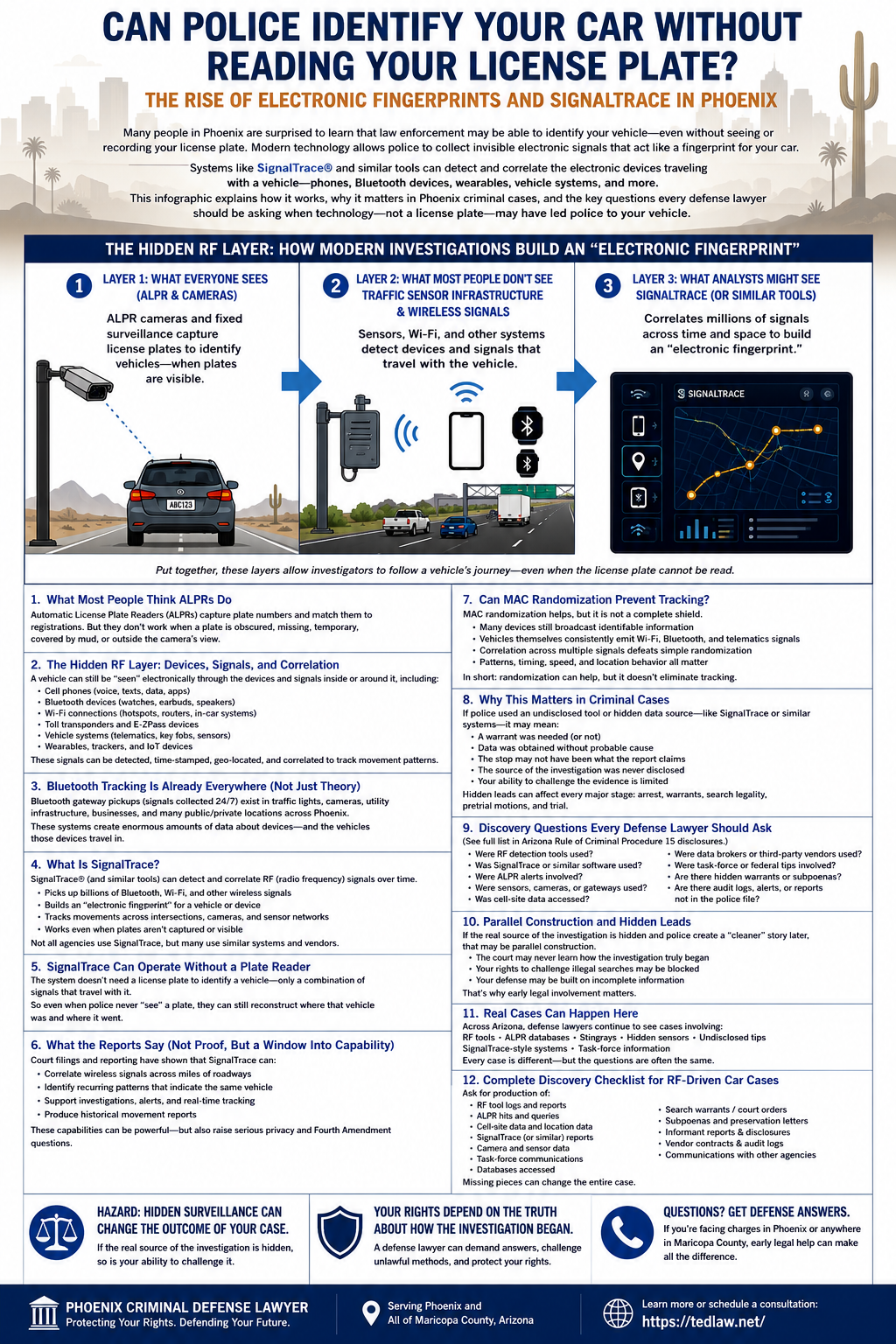
Public vendor materials, traffic-sensor documentation, investigative reporting, and privacy research show that modern vehicle surveillance can involve more than license plate reads. Some systems may detect signals from phones, Bluetooth devices, Wi-Fi sources, RFID tags, vehicle components, wearables, and other electronics that travel with or near a vehicle.
One example is SignalTrace, a technology marketed by Leonardo/ELSAG. Leonardo describes SignalTrace as an integrated signal intelligence system designed to identify suspect people or vehicles even when a license plate number is not known.
ELSAG SignalTrace – Leonardo DRS
The company’s materials describe the use of electronic devices and signal correlation in connection with vehicles, locations, timestamps, and license plate reader data when available.
That matters because if investigators can identify or track a vehicle by the devices traveling with it, the case may not begin with a plate read at all.
It may begin with the hidden RF layer.
If you want the broader legal framework first, start here:
What Is Parallel Construction? When Police Hide the Real Source of an Investigation in Phoenix
First Things First: What Is the Hidden RF Layer?
The hidden RF layer is the invisible cloud of radio-frequency signals surrounding modern life.
Your phone may emit wireless signals. Your smartwatch may communicate with your phone. Your earbuds may broadcast identifiers. Your vehicle may contain Bluetooth, Wi-Fi, tire-pressure sensors, infotainment systems, navigation equipment, hotspots, key fobs, RFID tags, or other electronic systems.
Standing alone, one signal may not prove much. But when signals repeatedly travel together, they can create a pattern.
That pattern may help identify:
- a vehicle,
- a device,
- a person associated with that device,
- a location history,
- or a repeated travel pattern.
For criminal defense purposes, the key question is not just whether a license plate was read. The key question is whether electronic signals helped law enforcement identify, locate, follow, or connect a vehicle to a person.
Why This Matters in Phoenix Criminal Cases
Phoenix is the largest city in Arizona and sits inside one of the busiest metropolitan areas in the Southwest. Criminal investigations in Phoenix may involve Phoenix Police, Maricopa County agencies, state investigators, federal task forces, private camera networks, automated license plate readers, and other data-sharing systems.
That does not mean every case involves advanced surveillance. Most cases do not. But in some investigations, especially those involving drugs, weapons, stolen vehicles, organized activity, trafficking allegations, or task-force operations, the defense may need to ask whether the official story tells the whole story.
If police say a case began with a traffic stop, the defense may still need to ask:
- Was the vehicle already being watched?
- Was an ALPR alert involved?
- Was a phone or Bluetooth signal detected?
- Was a federal agency involved?
- Was there a database search before the stop?
- Was there a hidden investigative lead?
These questions matter because the source of the evidence can affect suppression motions, discovery disputes, plea negotiations, and trial strategy.
For the full criminal case roadmap, see:
How SignalTrace Fits Into the Bigger Surveillance Picture
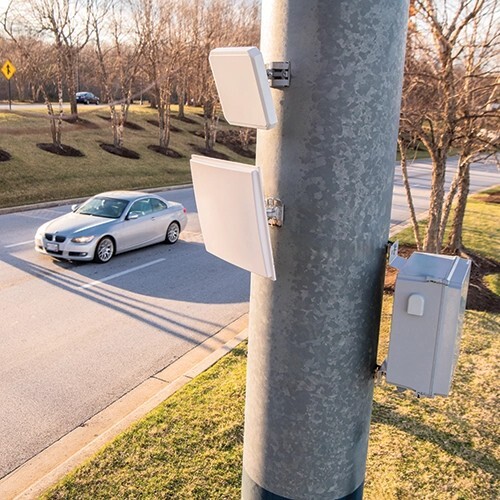
SignalTrace is important because it shows how vehicle surveillance may move beyond the license plate itself.
Traditional automatic license plate readers focus on plate numbers. A camera captures a plate, software reads it, and the system stores or compares the plate against databases.
SignalTrace-style systems suggest a broader concept: identify or correlate a vehicle based on electronic devices that repeatedly appear with it.
That could include categories such as:
- Bluetooth devices,
- Wi-Fi sources,
- RFID tags,
- vehicle components,
- phones,
- wearables,
- or other nearby electronic identifiers.
If those signals are linked to a vehicle, investigators may be able to recognize that vehicle later even when the plate is missing, obscured, changed, unreadable, or not the original starting point.
That is why criminal defense lawyers may need to ask whether a case involved only a plate read—or whether the State used a broader electronic fingerprint.
Automatic License Plate Readers Are Only One Part of the Story
Automatic license plate readers, often called ALPRs, are cameras that scan license plates and store plate, time, date, and location information.
ALPRs are already a major concern in privacy and criminal defense discussions because they can create a searchable record of vehicle movement.
But if license plate readers are combined with Bluetooth, Wi-Fi, RFID, or other device data, the surveillance picture can become much broader.
Instead of only asking:
“Was my plate read?”
The defense may also need to ask:
“Was my vehicle or phone recognized by another signal?”
That distinction can be crucial if the police report only mentions a routine traffic stop but the true investigative lead came from a database, sensor, or device-correlation system.
Bluetooth and Wi-Fi Tracking Are Not Science Fiction
Bluetooth and Wi-Fi signal detection has been used for traffic measurement and travel-time studies for years. Traffic systems can detect wireless identifiers from devices passing by sensors and compare detections at different locations to estimate travel times.
For example, transportation research has discussed using captured in-vehicle Bluetooth or Wi-Fi MAC addresses to estimate traffic performance and travel time.
U.S. Department of Transportation research – Wi-Fi MAC address travel-time estimation
Traffic technology vendors also market Bluetooth and Wi-Fi sensors for travel-time measurement and corridor monitoring.
SMATS Traffic Solutions – Bluetooth/Wi-Fi Travel Time Sensors
Those traffic systems are not the same as a criminal investigation. But they show an important point: devices in or near vehicles can emit signals that may be detected, compared, and analyzed.
When similar concepts enter criminal investigations, defense lawyers should be alert to discovery issues, reliability questions, and constitutional concerns.
Why This Can Become a Parallel Construction Problem
This topic connects directly to parallel construction.
Parallel construction happens when law enforcement uses one investigative source to find a lead, but later creates a cleaner official explanation for how the evidence was discovered.
In a Phoenix vehicle case, that might look like this:
- A hidden signal or database alert points police toward a vehicle.
- Officers locate the vehicle.
- Police wait for a traffic violation or claim a routine observation.
- The official report focuses on the stop, not the original signal-based lead.
That does not mean misconduct happened in every case. But if the true starting point is hidden, the defense may not know whether to challenge a search, subpoena, warrant, sensor, database, or data-sharing program.
For more on this issue, see:
What Is Parallel Construction? When Police Hide the Real Source of an Investigation in Phoenix
Why the Source of the Vehicle Identification Matters
How police identified a vehicle can matter as much as what they found later.
If officers lawfully saw a traffic violation and stopped a car, that is one type of case.
But if officers were already targeting the vehicle based on hidden electronic surveillance, the defense may need to examine:
- whether a warrant was required,
- whether a warrant existed,
- whether a private vendor supplied the data,
- whether the data was reliable,
- whether the system misidentified a vehicle,
- whether the data was disclosed in discovery,
- whether other agencies were involved,
- and whether the official report left out important facts.
These issues can affect complaint, indictment, arrest, arraignment, pretrial motions, plea negotiations, and trial.
Fourth Amendment Concerns: Searches, Tracking, and Location Data
The Fourth Amendment protects people from unreasonable searches and seizures.
Vehicle tracking, phone tracking, location data, and long-term surveillance can raise serious constitutional questions depending on how the data was obtained and used.
In Carpenter v. United States, the U.S. Supreme Court held that accessing historical cell-site location information generally requires a warrant because of the privacy interests involved in detailed location tracking.
Carpenter v. United States
Electronic fingerprinting is not the same legal issue as cell-site location information in every case. But Carpenter shows why courts take digital location data seriously.
If a Phoenix criminal case involves signals from phones, vehicles, Bluetooth devices, Wi-Fi sources, or location databases, the defense may need to investigate whether the government obtained and used that information lawfully.
Discovery Questions Defense Lawyers Should Ask
In a Maricopa County criminal case, discovery is where the defense begins asking how the investigation actually started.
Important questions may include:
- Was an automatic license plate reader used?
- Was the vehicle identified by anything other than its plate?
- Was SignalTrace or a similar system used?
- Were Bluetooth, Wi-Fi, RFID, or other device identifiers collected?
- Was any phone, wearable, hotspot, key fob, or vehicle component detected?
- Were traffic sensors, roadside sensors, or private cameras involved?
- Was data purchased from or received through a vendor?
- Was a federal, state, or local task force involved?
- Were there audit logs, alert records, reports, emails, or screenshots not included in the police report?
- Were any warrants, subpoenas, preservation requests, court orders, or database searches used?
These questions may be especially important during the preliminary hearing and pretrial conference stages.
What Police Reports May Leave Out
A police report may describe the visible part of the case, not the full investigative path.
Reports may mention:
- a traffic violation,
- a suspicious vehicle,
- an anonymous tip,
- or “information received.”
But they may not clearly describe:
- ALPR hits,
- Bluetooth or Wi-Fi detections,
- RFID or device-correlation data,
- federal task-force alerts,
- private camera network information,
- data-broker searches,
- surveillance technology logs,
- or internal communications between agencies.
That is why the defense should compare the report against body-camera footage, dispatch logs, CAD notes, warrant materials, officer testimony, database records, and discovery disclosures.
If the case began with an arrest, this guide may also help:
What Happens After a Felony Arrest in Phoenix, Arizona
Can Electronic Fingerprint Evidence Be Challenged?
Yes, depending on the facts.
The defense may be able to challenge:
- whether the technology was reliable,
- whether the data actually identified the defendant,
- whether the system produced false associations,
- whether the collection required a warrant,
- whether the State disclosed the evidence properly,
- whether the chain of custody is complete,
- whether the vendor data can be audited,
- and whether the officer’s report accurately described the investigation.
In some cases, the defense may request additional discovery. In other cases, the defense may file a motion to suppress evidence or challenge the reliability of the State’s evidence at a hearing.
Questions to Ask If Your Vehicle Was Identified Too Quickly
If police seemed to find a vehicle unusually fast, or if the report feels incomplete, useful questions may include:
- How did police first identify the vehicle?
- Was the license plate actually visible and readable?
- Was the car identified before the alleged traffic violation?
- Was an ALPR alert involved?
- Was a phone, Bluetooth device, or Wi-Fi signal connected to the vehicle?
- Were federal or task-force officers involved?
- Was there a confidential informant or database alert?
- Were any surveillance records omitted from the initial report?
These questions do not prove the case is invalid. But they can help determine whether the official story matches the actual investigation.
Frequently Asked Questions About Electronic Fingerprints and Vehicle Surveillance
Can police identify a car without reading the license plate?
In some situations, law enforcement may use other investigative leads, including vehicle descriptions, surveillance cameras, location data, electronic signals, informants, or database alerts. Some newer technologies are designed to correlate electronic devices with vehicles.
What is an electronic fingerprint in vehicle surveillance?
An electronic fingerprint refers to a pattern of devices or signals that may repeatedly travel with a vehicle, such as Bluetooth, Wi-Fi, RFID, phone, wearable, or vehicle-related identifiers.
What is SignalTrace?
SignalTrace is a technology marketed by Leonardo/ELSAG as an integrated signal intelligence system that can help identify suspect people or vehicles using electronic device correlation and license plate reader data when available.
Does this mean police used SignalTrace in my Phoenix case?
Not necessarily. This article discusses publicly documented technology and legal issues. Whether any particular tool was used depends on the facts, discovery, and agency records in the specific case.
Why does it matter how police identified my vehicle?
The source of the identification may affect whether the defense can challenge a search, traffic stop, warrant, database search, surveillance tool, or hidden investigative lead.
Can a defense lawyer request records about ALPRs, Bluetooth tracking, or device-correlation tools?
Yes. Depending on the case, a defense lawyer may request discovery, subpoena records, examine warrants and logs, and ask targeted questions about ALPRs, Bluetooth or Wi-Fi detections, vendor tools, task-force alerts, and database searches.
Can electronic surveillance evidence be suppressed?
Possibly. If evidence was obtained through an unconstitutional search or if important information was improperly withheld, the defense may be able to ask the court to suppress evidence or order additional disclosure.
Should I talk to police if I think my vehicle was tracked electronically?
No. It is usually best to remain silent and speak with a criminal defense lawyer before discussing the facts of the case.
Facing Criminal Charges in Phoenix? The Hidden RF Layer May Matter
Modern investigations may begin with much more than a license plate read. Vehicles, phones, wearables, Bluetooth devices, Wi-Fi sources, RFID tags, and other electronics can create data trails that are not always obvious from the first police report.
If you are facing charges in Phoenix or anywhere in Maricopa County, a criminal defense lawyer can examine how the investigation really began, whether hidden surveillance tools were involved, and whether your rights were violated.
Start here:
or request help here: