
Predictive Policing in Phoenix: Can Police Secretly Score You as a Risk?
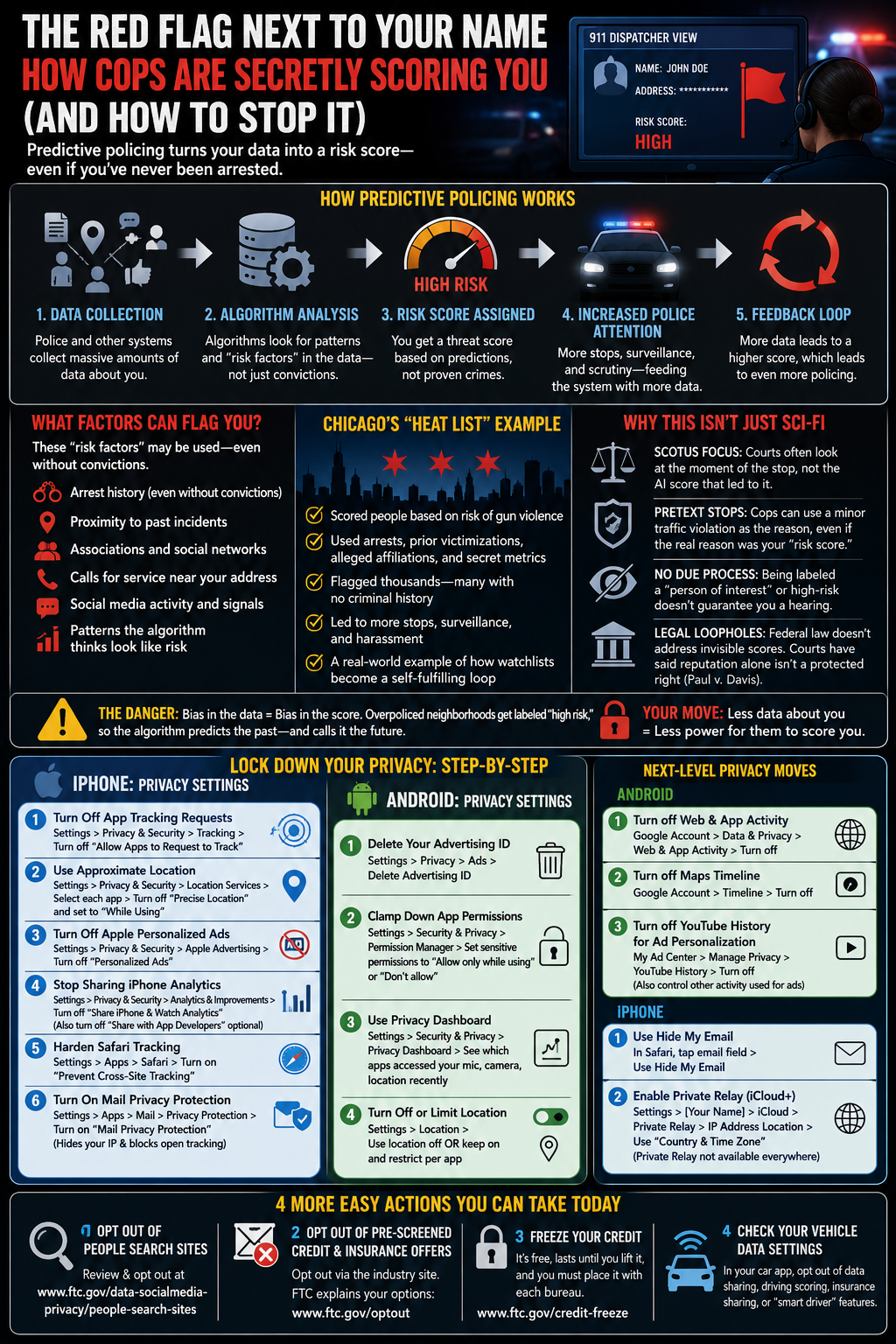
This article discusses publicly documented predictive policing tools, risk models, watchlist concerns, court decisions, and privacy steps. It does not claim that any specific person has been scored or that any specific Phoenix case involved predictive policing. Every case is different.
Imagine calling 911 in an emergency. The dispatcher pulls up your address, your name appears, and some system shows a warning flag next to it.
You have never been convicted of a crime. Maybe you have never even been charged.
But a database, algorithm, or police intelligence system has labeled you as a potential risk.
That is the concern behind predictive policing, police watchlists, and algorithmic risk scoring.
If you are facing criminal charges in Phoenix or anywhere in Maricopa County, one important question may be:
“Did police target me because of something I actually did, or because some system flagged me first?”
This guide explains what predictive policing is, how risk scores can affect police attention, why this matters in Phoenix criminal cases, and what defense lawyers may look for in discovery.
If you want the full criminal case roadmap first, start here:
This infographic explains how predictive policing tools can use data, patterns, and risk scores to influence police attention before anyone is charged with a crime.
First Things First: What Is Predictive Policing?
Predictive policing uses data, software, mapping, and algorithms to try to forecast where crime may happen or who may be involved in future crime.
The National Institute of Justice has described predictive policing as using information, geospatial technologies, and intervention models to reduce crime and improve public safety.
National Institute of Justice – Overview of Predictive Policing
RAND has also explained that predictive policing tools can include both technical prediction methods and tactical approaches for acting on those predictions.
RAND – The Role of Crime Forecasting in Law Enforcement Operations
In plain English, predictive policing tries to answer questions like:
- Where is crime likely to happen?
- Who is likely to be involved in crime?
- Who is likely to become a victim?
- Where should police patrol more often?
- Which people, vehicles, locations, or groups should receive more police attention?
The concern is that these systems may influence police decisions before anyone has been convicted of anything.
The Two Main Types of Predictive Policing
Predictive policing usually falls into two broad categories.
1. Place-Based Predictive Policing
Place-based systems focus on locations. These tools may use past police reports, arrests, calls for service, or incident data to identify “hot spots.”
The result may be more patrols in a neighborhood, business district, apartment complex, parking lot, or street corridor.
2. Person-Based Predictive Policing
Person-based systems focus on people. These tools may try to identify who is supposedly likely to commit a crime, become a victim, or become involved in violence.
That is where the risk-score problem becomes serious.
A person-based model may consider factors such as:
- arrest history, even without convictions,
- prior police contacts,
- calls for service near an address,
- known associations,
- alleged gang or group affiliation,
- victimization history,
- social media or digital information,
- or patterns the software treats as risky.
That can create a major fairness problem. A person may be treated as suspicious not because of what they did, but because an algorithm says their profile looks risky.
Why Predictive Policing Matters in Phoenix Criminal Cases
Phoenix is the largest city in Arizona and sits within one of the busiest metropolitan areas in the Southwest. Criminal investigations here may involve Phoenix Police, Maricopa County agencies, state investigators, federal task forces, shared databases, private camera systems, license plate readers, and other surveillance tools.
That does not mean every Phoenix case involves predictive policing. Most cases do not.
But in some cases, especially investigations involving drugs, weapons, stolen vehicles, alleged gangs, repeat locations, task forces, or surveillance-heavy policing, the defense may need to ask whether the official police report tells the whole story.
Important questions may include:
- Was the person already on a watchlist?
- Was the address flagged before police arrived?
- Was the vehicle already being monitored?
- Did a risk score influence the officer’s attention?
- Was a database alert involved?
- Was the stop or search connected to a hidden investigative lead?
For more on how hidden investigative leads can affect a case, see:
What Is Parallel Construction? When Police Hide the Real Source of an Investigation in Phoenix
The Chicago “Heat List” Example
One of the most widely discussed examples of person-based predictive policing was the Chicago Police Department’s former Strategic Subject List, sometimes called the “heat list.”
The City of Chicago Office of Inspector General reviewed Chicago’s former predictive risk models, including the Strategic Subject List and the Crime and Victimization Risk Model. Those models were designed to predict whether someone would become a “party to violence,” meaning a victim or offender in a shooting.
Chicago Office of Inspector General – Predictive Risk Models Advisory
The Chicago example matters because it shows how a watchlist or risk model can move from theory into real policing.
Once someone is labeled high-risk, police attention may increase. More attention can lead to more stops, more reports, more database entries, and more future suspicion.
That creates a feedback loop:
- Police data labels a person or area risky.
- Police increase attention on that person or area.
- More police attention creates more police records.
- The system treats those new records as more proof of risk.
- The person or area remains under heavier scrutiny.
That is one reason critics argue that predictive policing can reproduce old policing patterns while making them look objective.
The Feedback Loop Problem: Predicting the Past and Calling It the Future
Predictive policing systems often learn from historical police data.
That may include:
- arrests,
- stops,
- calls for service,
- complaints,
- incident reports,
- field interview cards,
- and prior enforcement patterns.
But historical police data is not the same thing as neutral truth.
If one neighborhood has been heavily patrolled for years, there will naturally be more police records from that neighborhood. A predictive model may read that data and conclude the neighborhood needs even more police attention.
The algorithm may not ask whether the area was over-policed. It may simply say:
“More police activity happened here, so more risk exists here.”
That is how old enforcement patterns can become automated.
How Risk Scores Can Affect Police Encounters
A police risk score may not appear in the official report. It may not be listed as the reason for a stop. It may not be disclosed to the defense unless someone asks the right questions.
But it can still matter.
A risk score, database alert, or watchlist flag may influence:
- which person officers watch,
- which vehicle officers follow,
- which address gets extra patrols,
- how officers interpret ordinary behavior,
- whether a traffic stop happens,
- whether backup is called,
- or whether officers escalate quickly.
In a criminal defense case, that can matter because the defense may need to know why the police focused on a person in the first place.
Pretext Stops: Why the Official Reason May Not Be the Real Reason
One reason predictive policing is difficult to challenge is the doctrine of pretext stops.
In Whren v. United States, the U.S. Supreme Court held that an officer’s subjective motive generally does not invalidate a traffic stop if there is an objective traffic violation supporting the stop.
Whren v. United States, 517 U.S. 806 (1996)
That matters because if an officer follows a person because of a risk score, database flag, or watchlist alert, the officer may later justify the stop based on a traffic violation.
For example:
- A system flags a person or vehicle.
- Officers begin watching the vehicle.
- The driver commits a minor traffic violation.
- The official report focuses on the traffic violation.
- The hidden scoring or watchlist issue may never appear.
That is why predictive policing can connect directly to parallel construction and hidden investigative leads.
Due Process Problems: Can You Challenge a Secret Score?
One of the biggest problems with police risk scoring is that people may never know they were scored.
If the system is treated as an internal law enforcement tool, the person may receive:
- no notice,
- no hearing,
- no appeal,
- no explanation of the data used,
- and no clear way to correct mistakes.
In Paul v. Davis, the U.S. Supreme Court held that harm to reputation alone does not automatically create a constitutional due process claim.
Paul v. Davis, 424 U.S. 693 (1976)
That does not mean every risk-score system is lawful. It does mean that challenging secret police labels can be difficult, especially when the government argues that the score is only an internal intelligence tool.
Location Data and the Carpenter Line of Cases
There is still an important constitutional limit.
In Carpenter v. United States, the U.S. Supreme Court held that the government generally needs a warrant to access historical cell-site location information because detailed location tracking reveals deeply private information.
Carpenter v. United States
Carpenter does not solve every predictive policing issue. It does not automatically cover every database, score, or risk model.
But it shows that courts recognize a serious privacy interest when the government uses digital data to track people over time.
If a Phoenix criminal case involves phone location data, license plate reader history, data-broker information, app data, or long-term surveillance, the defense may need to investigate whether a warrant was required.
What Defense Lawyers Look for in Discovery
In a Maricopa County criminal case, discovery is where the defense starts asking how the investigation really began.
Important discovery questions may include:
- Was any predictive policing tool used?
- Was the defendant on a watchlist, hot list, or risk list?
- Was the address, vehicle, phone, or name flagged before police contact?
- Was a risk score visible to dispatch or officers?
- Was an ALPR alert involved?
- Was there a database search before the stop?
- Was any federal, state, or local task force involved?
- Were any intelligence bulletins, officer-safety alerts, or BOLOs created?
- Were any internal notes, screenshots, audit logs, or emails omitted from the police report?
- Was location data, social media data, or third-party data used?
These questions may matter during the preliminary hearing, pretrial conference, motion practice, plea negotiations, and trial.
How Predictive Policing Can Affect the Official Story
A police report may say:
- “officers were in the area,”
- “officers observed suspicious behavior,”
- “officers conducted a traffic stop,”
- “officers acted on information received,”
- or “officers developed information.”
Those phrases do not prove misconduct.
But they can raise questions.
The defense may need to ask whether the report leaves out:
- a risk score,
- a watchlist hit,
- a predictive policing alert,
- a task-force bulletin,
- a database search,
- a license plate reader alert,
- or an intelligence note sent before the stop.
For more on this issue, see:
What Is Parallel Construction? When Police Hide the Real Source of an Investigation in Phoenix
Can Predictive Policing Evidence Be Challenged?
Yes, depending on the facts.
A defense lawyer may challenge:
- whether the system was reliable,
- whether the data was accurate,
- whether the score was based on arrests instead of convictions,
- whether the model used biased historical data,
- whether the State disclosed the tool,
- whether a warrant was required for underlying data,
- whether the officer’s report omitted the true investigative lead,
- and whether the stop, search, or seizure was constitutional.
Possible defense responses may include:
- requesting additional discovery,
- subpoenaing records when appropriate,
- seeking audit logs or database records,
- cross-examining officers about the source of the investigation,
- filing a motion to suppress evidence,
- or challenging the reliability of the State’s theory.
For the broader timeline of how a criminal case moves forward, see:
Privacy Steps That May Reduce Data Exposure
No privacy setting can guarantee that you will never appear in a law enforcement database. But reducing unnecessary data collection can still help limit the amount of information available through apps, brokers, advertisers, and connected services.
Phone Privacy Settings
- Turn off unnecessary app tracking.
- Limit precise location access for apps that do not need it.
- Review which apps recently accessed your location, microphone, or camera.
- Turn off personalized advertising where possible.
- Delete or reset advertising identifiers when available.
Apple provides privacy controls for tracking, location, analytics, advertising, and Safari privacy settings.
Apple – App Tracking Transparency
Google also provides controls for ad personalization, activity history, and location settings.
Google Account Help – Control Activity Saved to Your Account
People-Search and Data Broker Opt-Outs
People-search sites and data brokers may publish or sell personal information. The FTC explains how these data broker and people-search services can affect consumer privacy.
FTC – How to Protect Your Privacy Online
Credit and Identity Protections
Freezing your credit can reduce identity-theft risk and limit unauthorized new credit accounts. The FTC explains that credit freezes are free and must be placed with each credit bureau.
FTC – Credit Freezes and Fraud Alerts
Vehicle and Connected-Car Settings
Many newer vehicles and connected-car apps include data-sharing settings. Review the app or vehicle account for terms such as:
- driving score,
- smart driver,
- insurance sharing,
- connected services,
- location sharing,
- telematics,
- or diagnostics sharing.
If you do not want that data shared, look for opt-out settings or contact the provider directly.
Questions to Ask If You Think You Were Flagged
If a police encounter felt unusually targeted, useful questions may include:
- Why were officers watching me?
- Why did police come to my address?
- Was my name, vehicle, phone, or address flagged before contact?
- Was dispatch showing an officer-safety alert?
- Was a database search done before the stop?
- Was there a BOLO or intelligence bulletin?
- Did any task-force officer provide information?
- Was the official report missing the real starting point?
Those questions do not prove the case is invalid. But they can help reveal whether a hidden score, watchlist, or predictive policing tool played a role.
Frequently Asked Questions About Predictive Policing
What is predictive policing?
Predictive policing uses data, software, mapping, and algorithms to try to forecast where crime may happen or who may be involved in future crime.
Can police assign people risk scores?
Some police agencies have used person-based risk models or watchlists designed to estimate whether someone may be involved in future violence or crime. The details vary by agency and system.
Does a risk score mean I committed a crime?
No. A risk score is not a conviction and does not prove guilt. The concern is that a score may influence police attention before any charge or conviction.
Can predictive policing lead to more stops?
Potentially. If a person, vehicle, address, or area is flagged as risky, officers may pay closer attention, which can lead to more stops, checks, reports, or searches.
Is predictive policing always illegal?
No. Predictive policing is not automatically illegal, but it can raise serious Fourth Amendment, due process, discovery, bias, and fair-trial concerns depending on how the system is used.
Can a defense lawyer ask whether predictive policing was used?
Yes. A defense lawyer may ask targeted discovery questions about risk scores, watchlists, ALPR alerts, dispatch flags, database searches, task-force bulletins, and hidden investigative leads.
Can evidence be suppressed because of a predictive policing score?
Possibly, but it depends on the facts. Suppression may be available if evidence came from an unconstitutional stop, search, seizure, or undisclosed investigative method.
Should I talk to police if I think I was flagged by a watchlist?
No. It is usually best to remain silent and speak with a criminal defense lawyer before discussing the facts of the case.
Facing Criminal Charges in Phoenix? The Data Trail May Matter
Modern policing may involve more than what appears in the first police report. A case may begin with patrol observations, but it may also involve database searches, risk flags, license plate readers, dispatch notes, watchlists, or hidden investigative leads.
If you are facing charges in Phoenix or anywhere in Maricopa County, a criminal defense lawyer can examine how the investigation really began and whether your rights were violated.
Start here:
or request help here: