The “Digital Plant” Defense: When Data Infiltrates Your Phone Without Your Knowledge
This article examines digital forensic science standards, federal and Arizona evidentiary rules, mobile operating system architectures, database journaling mechanics, and allegations emerging from international cyber incidents. It explores the technical reality that modern smartphones are multi-writer network environments. Nothing in this article creates an attorney-client relationship; it serves as an evidentiary guide for defendants facing digital charges in Phoenix, Tempe, and across Maricopa County.
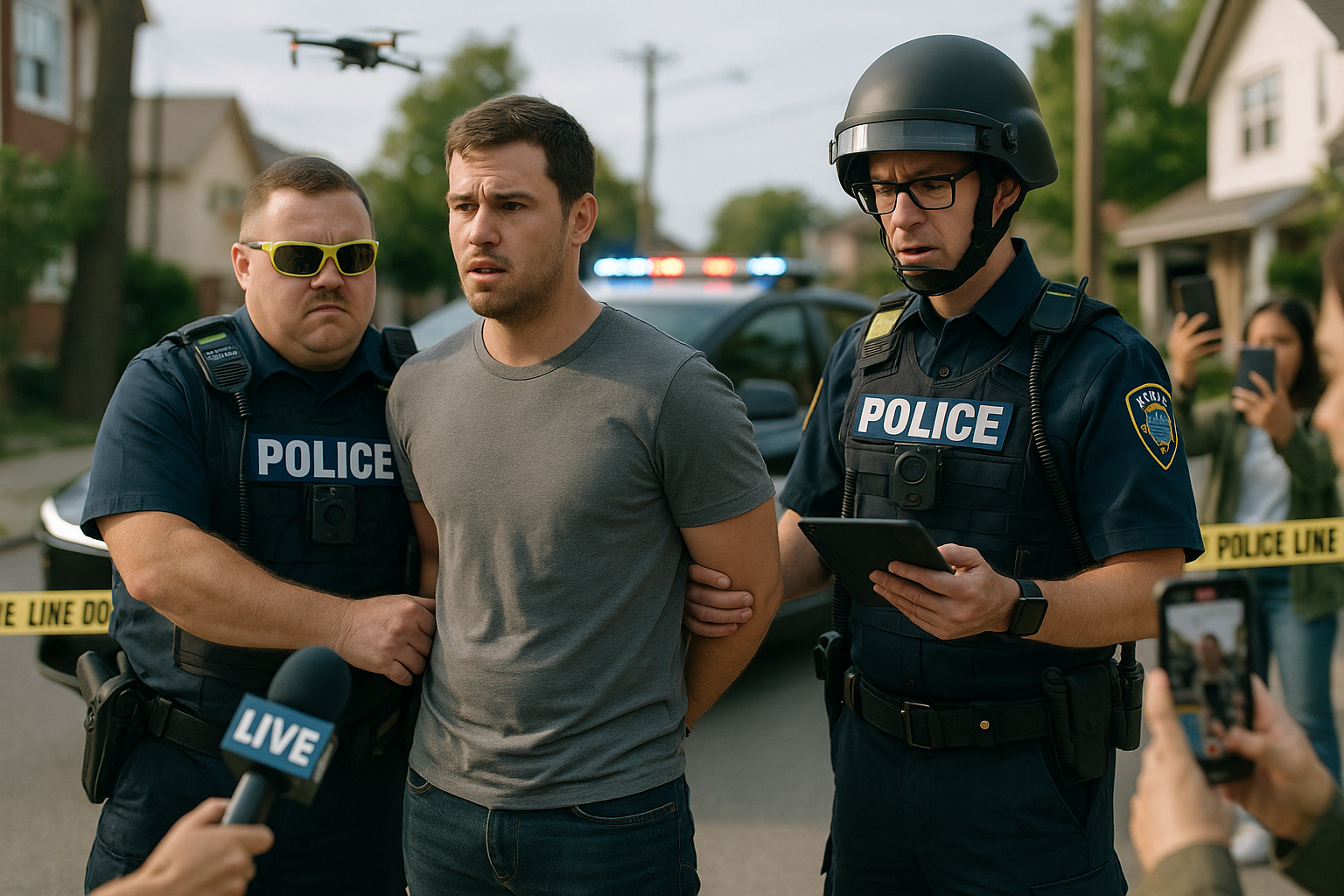
You wake up in an interview room at Phoenix Police headquarters on West Washington Street, or following an arrest near the ASU campus by Tempe Police.
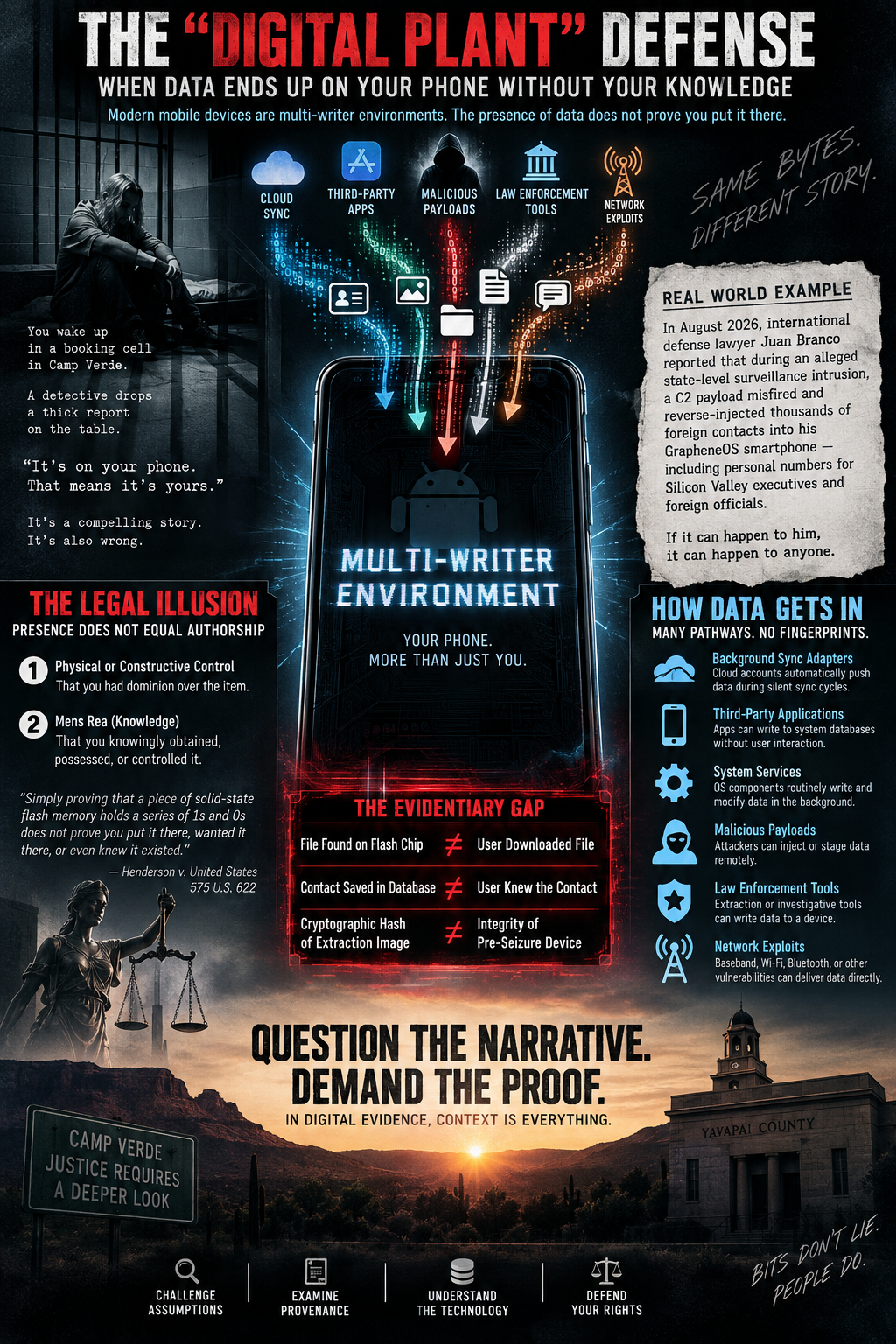
A detective slides a thick digital forensics report across the table, taps a highlighted row on a spreadsheet, and points to an incriminating text thread, an illicit contact card, a cryptocurrency wallet address, or a deleted file.
Then they deliver the line designed to break your resolve:
“It’s on your phone. That means you put it there.”
In Maricopa County courtrooms, prosecutors rely on that single assumption to secure grand jury indictments. The legal doctrine is called constructive possession. The State’s theory is simple: you owned the device, the device contains the contraband or communication, therefore you knowingly possessed and controlled it.
It sounds open-and-shut to a jury. But from a software and hardware engineering standpoint, it is fundamentally untrue.
An international cyber incident highlighted what forensic experts have understood for years. Juan Branco, a French attorney handling sensitive matters before the International Criminal Court (ICC), reported an anomaly on his hardened GrapheneOS smartphone. During an alleged state-level surveillance intrusion, an external command-and-control (C2) payload misfired. Instead of silently exfiltrating files, the external process malfunctioned and reverse-injected thousands of outside contacts including private numbers for prominent tech founders and foreign government officials directly into his local phone database.
While mainstream commentators covered this as an intelligence blunder, criminal trial lawyers recognize the core legal principle: an empirical demonstration of the “Digital Plant” defense.
If an external server, an automated cloud synchronization protocol, a rogue third-party application, or a police laboratory extraction tool can stage, write, or inject data onto a device without the user ever touching the screen, the prosecution’s presumption of knowing possession fails.
1. The Evidentiary Divide: Presence Is Not Authorship
In any criminal prosecution whether an indictment involves alleged drug trafficking ledgers, white-collar wire fraud, identity theft, or digital contraband the State must prove two independent statutory elements under Arizona law (A.R.S. § 13-105) and federal law:
- Physical or Constructive Control: That you exercised dominion over the specific item.
- Mens Rea (Knowledge): That you knowingly acquired, possessed, or controlled that exact data.
The United States Supreme Court held in Henderson v. United States (575 U.S. 622) that constructive possession requires both the power and the intention to exercise direction and control over the item.
Simply demonstrating that solid-state flash memory contains a specific binary file does not prove you placed it there, intended it to be there, or knew it existed.
In United States v. Flyer (633 F.3d 911), the Ninth Circuit drew a clear evidentiary distinction regarding files located in unallocated cluster space, holding that the mere forensic existence of a digital file cannot substitute for affirmative proof of knowing possession.
Furthermore, under Federal Rule of Evidence 901 and Arizona Rule of Evidence 901, the government must authenticate digital evidence by proving the item is what the proponent claims it to be. In United States v. Vayner (767 F.3d 114), the Second Circuit reversed a conviction because the prosecution failed to prove that the defendant actually created or authored the digital profile in question, ruling that showing a name or file on a device does not establish its creator.
THE LITIGATION REALITY
Data on Flash Memory≠User Generated the Data
Record in Database≠User Knew the Record Existed
Hash of Forensic Image≠Proof the Physical Phone Was Unaltered
2. The Multi-Writer Reality: How Data Enters Modern Devices
Police investigators often portray smartphones as simple digital diaries. In reality, a smartphone is a networked computer executing concurrent operating system tasks, cloud sync daemons, and background read/write database transactions.
Modern mobile operating systems like Android do not store contacts, text messages, or media in a single flat file. Android’s ContactsProvider architecture relies on a multi-source aggregation model. It links records across Google accounts, Microsoft Exchange, Nextcloud, SIM cards, secure messaging apps (Signal, Telegram, WhatsApp), and background daemons into a centralized relational SQLite database: contacts2.db.
Data commits to local databases through numerous automated vectors without requiring manual user input:
- Cloud Sync Adapters: External servers push contact cards, shared calendars, message updates, and remote tokens during background maintenance cycles.
- Third-Party Application Daemons: Applications granted standard permissions can execute write transactions directly through local content provider APIs.
- Paired Host Workstations: If a phone was tethered to a laptop or desktop via USB with Android Debug Bridge (ADB) or media synchronization enabled, a compromised or misconfigured host computer can push files directly into application storage.
- Payload Execution & Rollback Failures: As demonstrated in the Juan Branco matter, when external surveillance tools or zero-day memory exploits encounter errors, automated rollback protocols can invert exfiltration tasks, committing external staging rows directly into local device databases.
3. Forensic Extraction Tools Modify Target Devices
When an expert witness for the prosecution testifies in Maricopa County Superior Court, they routinely assert:
“We used industry-standard Cellebrite UFED or GrayKey systems. The process is completely passive and read-only.”
That claim collapses under technical scrutiny.
While forensic software does not alter the *output image file* once created and hashed, extracting data from a locked, modern smartphone often requires altering the state of the target device itself.
Published patent records demonstrate how these forensic platforms operate:
- Magnet Forensics Patent (US 12,613,987 B2, Issued April 28, 2026): Titled “Digital forensics access and extraction,” this patent describes an extraction device that deploys and installs an access agent directly onto the target phone. The agent collects device artifacts, creates target-side storage structures, transforms into an extraction agent, and is subsequently removed.
- Cellebrite Patent (US 12,069,151 B2): Discloses methods where an external computer pushes an Android collection agent via ADB or MTP interfaces to extract data from protected application directories.
- Oxygen Forensics Android Agent: Publicly details the routine installation of an executable application pushed onto the connected Android device to bypass standard operating system restrictions and parse records.
Consider the evidentiary implications for a defense case in Phoenix or Tempe:
Police take custody of a seized phone. They connect it to an extraction workstation. The workstation pushes an executable software agent *into* the phone’s operating environment. That software runs processes, creates temporary files, stages records, and deletes itself post-acquisition.
The state then provides the defense with a SHA-256 hash showing that the forensic copy hasn’t changed since the detective saved it to an external drive.
A post-extraction hash proves that the police did not alter their working copy. It does not prove what their software altered on your physical phone before or during the extraction.
4. Technical Auditing: The Low-Level Evidence We Analyze
Asserting that evidence was “planted” or arrived through a “glitch” without technical support will be rejected by an Arizona trial judge as speculative.
A proper defense must be built on verifiable low-level artifacts:
A. Analyzing the SQLite Write-Ahead Log (-wal)
Modern mobile databases do not write directly to main database storage files in real time. They stage operations in a temporary transactional journal known as a Write-Ahead Log (WAL). If the forensic extraction is conducted properly, the accompanying .db-wal and .db-shm files preserve the chronological transaction record. We examine:
- Commit Timestamps: Did the disputed record commit at a time when phone logs show the screen was dark, the device was locked, or the user was asleep?
- Linux User ID (UID) Verification: Android assigns every application its own distinct Linux UID. Did the entry originate from user interaction within the app, or was it written by a background system daemon or unmapped package?
- Batch Write Signatures: Were dozens or hundreds of rows inserted within milliseconds indicating automated API synchronization rather than human typing?
B. Hardware Memory Tagging Extension (ARM MTE) Fault Logs
On newer hardware (such as Google Pixel 8, Pixel 9, and Pixel 10 devices) running hardened operating systems like GrapheneOS, hardware enforces ARM MTE. MTE prevents memory exploits by assigning matching 4-bit tags to pointers and memory blocks.
When commercial spyware attempts a classic Use-After-Free exploit to gain unauthorized root access, the processor identifies the tag mismatch and generates an immediate fault. Reviewing crash dumps and kernel panic logs can determine if a hardware memory fault coincided with unexplained database activity.
5. The Defense Protocol for Digital Evidence in Arizona
Many defense attorneys treat digital evidence like a black box, accepting hundreds of pages of parsed Cellebrite spreadsheets without challenge.
Under ABA Model Rule 1.1, Comment 8, defense counsel has an ongoing professional duty to understand the risks and benefits associated with relevant technology. In modern criminal litigation, this technical competence is essential.
When our firm defends a client facing digital evidence charges in Maricopa County Superior Court or federal court in Phoenix, we follow a rigorous litigation protocol:
Step 1: Compelling the Native Bit-Stream Image
Under Arizona Rule of Criminal Procedure 15.1 and Federal Rule of Criminal Procedure 16(a)(1)(E), we file motions demanding the unparsed bit-stream forensic image (E01, RAW, or DD format), along with all original -wal and -shm database journals. A PDF printout is hearsay; the raw byte stream is the evidence.
Step 2: Subpoenaing Tool Configurations and Extraction Logs
We demand the exact software versions, firmware builds, and technical protocols used by the investigating crime lab. If the extraction platform deployed an executable target agent (under Magnet or Cellebrite patents), we demand the access logs detailing every command executed and file created or deleted during processing.
Step 3: Filing Motions Under Rules 901 and 702
If the prosecution cannot establish who authored the data, we move for exclusion under Rule 901 (Lack of Authentication) and Rule 702 (Scientific Reliability). If the state’s extraction methodology modified the physical device without preserving pre-acquisition baselines, we assert due process and spoliation challenges under Arizona v. Youngblood and California v. Trombetta.
6. Cross-Examining the State’s Digital Forensics Expert
When law enforcement analysts testify about phone extractions, cross-examination should focus on the technical boundaries of their tooling:
- “Detective, you did not observe my client type or save this disputed file, correct?”
- “Your entire conclusion is based on finding the record in the phone’s storage directory?”
- “The Android operating system permits background cloud sync adapters, apps, and system daemons to write records without user interaction, correct?”
- “When you connected the phone to your forensic workstation, did your tool deploy an executable agent onto the phone?”
- “Did you calculate a SHA-256 cryptographic hash of the phone’s physical flash storage *before* that software agent executed on the device?”
- “Did you analyze the SQLite Write-Ahead Log to determine which specific Process ID and UID committed this transaction?”
- “Your software parser cannot determine whether a row was entered by human keystrokes or an automated background sync routine, can it?”
7. Frequently Asked Questions: Digital Evidence & Smartphone Defense
Can files end up on my phone without me downloading them?
Yes. Background cloud syncing, shared account drives, third-party application tasks, mobile malware, and tethered PC sync routines can all commit files and database entries without user alerts or active intervention.
Does a police Cellebrite report prove I committed a crime?
No. A Cellebrite report is an automated parsing of data residing on a device at the time of extraction. It does not prove who authored the data, how it arrived, whether an external process injected it, or whether you had knowing dominion over it.
What does a cryptographic hash actually prove?
A cryptographic hash (such as SHA-256) taken after extraction proves that the police working copy has not been altered since the image was generated. It does not prove that the physical device remained unaltered before or during the extraction process.
How does running GrapheneOS affect a criminal investigation?
GrapheneOS incorporates hardened memory allocation, USB connection blocking, and support for hardware Memory Tagging (ARM MTE). These controls mitigate common exploit vectors and generate system logs that can help demonstrate whether an unauthorized intrusion occurred.
Facing Charges Involving Digital Evidence in Phoenix or Tempe? Audit the Code.
When facing felony charges in Maricopa County, you cannot allow the prosecution to treat digital forensics as an unchallenged black box.
Whether your case involves white-collar financial allegations, drug trafficking charges, computer offenses, or complex felony proceedings in Phoenix, Tempe, Mesa, Scottsdale, Chandler, or Glendale, you have the constitutional right to challenge machine-generated evidence.
We analyze the code, the database commit journals, and the extraction logs to ensure the State is held to its burden of proof.
Start your defense strategy here:
Phoenix & Tempe Criminal Defense Lawyer – Ted Law
Review the procedural timeline of an Arizona criminal case:
Arizona Criminal Defense Resources & Case Stages
Call 602-453-3100
Ted Agnick | DUI & Criminal Attorney
2233 W Baseline Road, Ste. C-101
Tempe, AZ 85283
 This article discusses publicly documented forensic standards and vendor security architecture. It does not claim that any particular method was used in any specific case.